News
Tesla recalls about 10,500 Powerwall 2 home batteries for overheating
- Event date
- Effective
- Published
- Last updated
Background. This event is more than 90 days old. We keep it for reference; it is not current news. Recalls stay in force until the maker says otherwise, so the checks below still apply.
What changed at a glance
| Item | Before | Now | Source date |
|---|---|---|---|
| Tesla Powerwall 2 (certain units sold Nov 2020 to Dec 2022) | In service | Recalled; Tesla replacing affected units |
What changed
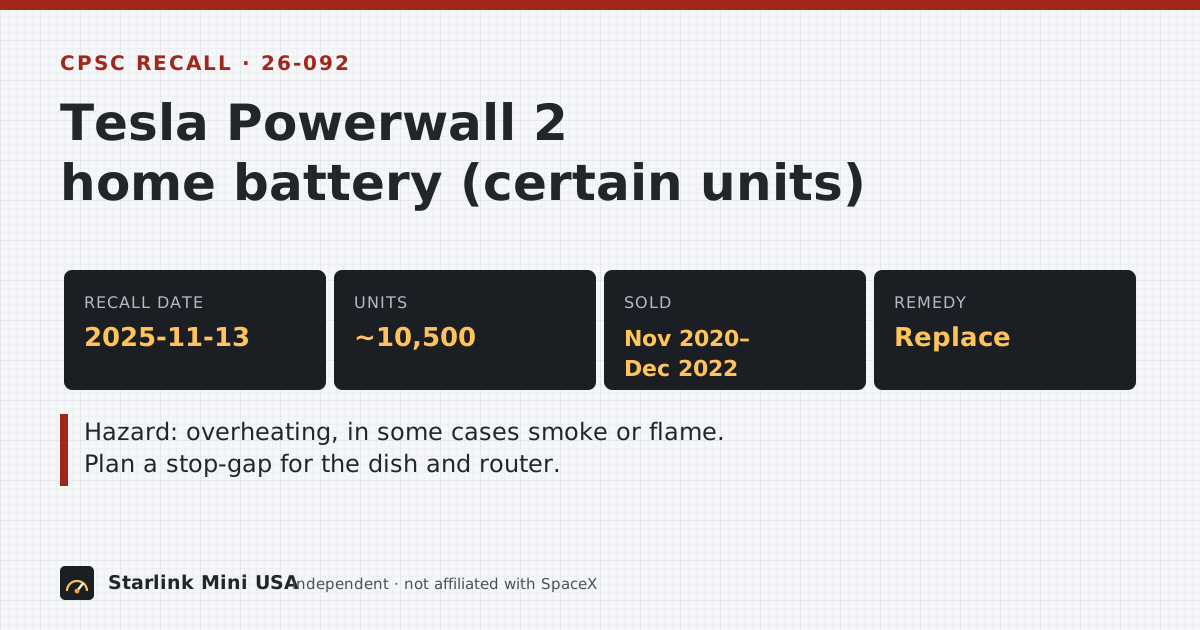
On November 13, 2025, the CPSC and Tesla announced a recall of about 10,500 Tesla Powerwall 2 home battery systems (recall 26-092). Powerwall 2 is a wall-mounted AC battery that stores energy for a home, often paired with rooftop solar, and many owners use it to ride through grid outages.
The CPSC notice says certain units can fail in a way that leads to heat, smoke or fire:
“The lithium-ion battery cells in certain Powerwall 2 systems can cause the unit to stop functioning during normal use, which can result in overheating and, in some cases, smoke or flame and can cause death or serious injury due to fire and burn hazards.”
Tesla received 22 reports of overheating, including six of smoking and five fires with minor property damage. No injuries were reported. The affected units were sold through Tesla.com/powerwall and certified installers nationwide from November 2020 through December 2022, at about $8,000. The remedy is a replacement.
Who it affects
Homeowners with a Powerwall 2 installed from late 2020 through 2022. Not every Powerwall 2 from that period is affected: the notice says “certain” systems, and Tesla identifies them. Newer Powerwall models are not named in this recall.
This is the outage-proofer’s case on our site: a Residential Starlink dish and router kept online by a home battery. If your home internet backup runs through a Powerwall 2, the recall can affect both your safety and your outage plan.
What it means for your power setup
A home battery is a much larger system than a Starlink needs. Starlink’s help center lists the Standard dish at up to about 100 W on average (value from our data file below), so even a small share of a home battery can run the dish and router for a long time. That’s why many Powerwall owners never think about Starlink’s draw.
If your unit is being replaced, there may be a period with reduced or no backup. During that time, a small UPS or power station dedicated to the dish and router is the low-cost bridge. Our UPS for the home dish guide shows how to size one, and the outage guide covers the rest of the plan. Starlink’s own power figures are on the watts table.
What to do
- Check whether your Powerwall 2 is in the recall: tesla.com/support/energy/powerwall/own/powerwall-2-replacement, powerwallsupportna@tesla.com, or 877-961-7652 (8 a.m. to 5 p.m. PT, Monday to Friday).
- Follow Tesla’s instructions for your unit. The CPSC notice lists the remedy as “Replace”.
- If you rely on the Powerwall to keep internet up during outages, set up a stop-gap for the dish and router while you wait.
- Don’t try to open or service a home battery yourself.
What stays the same
- Starlink’s published power figures for the Standard dish and Mini: unchanged.
- Our UPS sizing method: unchanged.
- Powerwall models other than Powerwall 2: not named in this recall.
What we don’t know yet
- How long replacements take. The notice doesn’t say.
- Whether Tesla limits affected units remotely before replacement. The CPSC notice doesn’t say; ask Tesla if your unit’s behavior has changed.
Values from our data files
These render from the site’s fact store, with where each came from and when we checked it.
- Standard averages up to 100 W. Official spec: From a Starlink specification sheet or help article. Checked Oct 5, 2026 (checked )
Source
- CPSC: Tesla Recalls Powerwall 2 AC Battery Power Systems Due to Fire and Burn Hazards; Risk of Serious Injury or Death (recall 26-092) (Primary source; source dated ; retrieved )
Update notes
No updates since publication.
Corrections
No corrections since publication. Spotted an error? Tell us.