Key takeaways
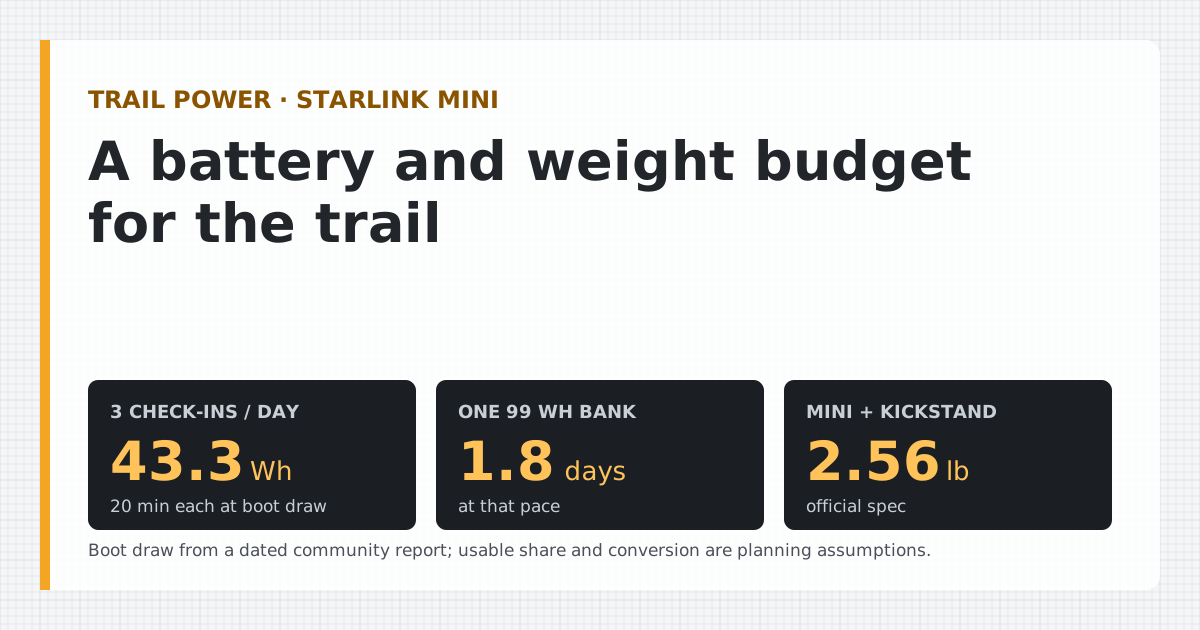
- Plan sessions, not hours online. Three 20-minute check-ins a day cost about 43.3 Wh from the battery even if every session runs at boot-level draw (39 W Community report: A dated measurement posted by an owner, cited. Checked Oct 5, 2026 Community report: A dated measurement posted by an owner, cited).
- At that pace one 99 Wh USB-C bank (79.2 Wh usable Planning assumption: Our stated assumption, used until bench results replace it) lasts about 1.8 days. A 3-day trip needs 2 banks.
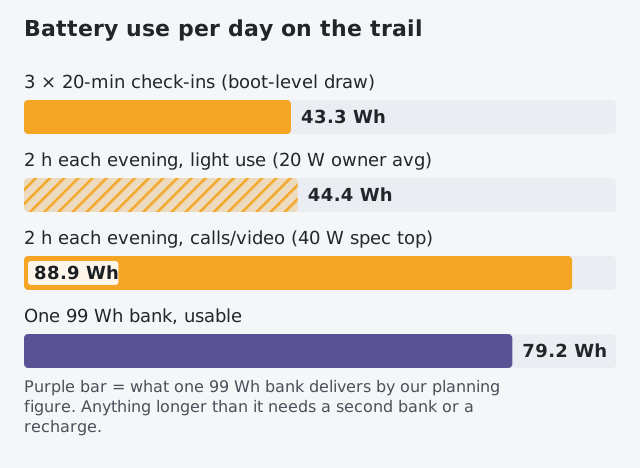
- Two hours online every evening costs 44.4–88.9 Wh a day, more than one bank holds at the top of Starlink's range.
- The Mini weighs 2.43 lb Official spec: From a Starlink specification sheet or help article. Checked Oct 5, 2026 bare and 2.56 lb Official spec: From a Starlink specification sheet or help article. Checked Oct 5, 2026 with its kickstand. Leaving the 15 m DC cable at home saves 0.8 lb; you'll power it by USB-C anyway.
- Your bank needs a 100 W USB-C PD port (20 V / 5 A) and Starlink's USB-C to barrel cable. 65 W banks won't run it.
For a multi-day hike, plan short, scheduled check-ins: three 20-minute sessions a day cost about 43.3 Wh from the battery, so one 99 Wh USB-C power bank lasts about 1.8 days and a 3-day trip needs 2 banks. Leave the Mini on for a couple of hours every evening and you need more than a bank a day. The Mini itself weighs 2.56 lb Official spec: From a Starlink specification sheet or help article. Checked Oct 5, 2026 with its kickstand; the batteries are where the weight piles up.
Why sessions beat “always on” on the trail
A Mini that’s left on draws power whether or not you use it: Starlink lists 15 W Official spec: From a Starlink specification sheet or help article. Checked Oct 5, 2026 at idle. On a power bank that idle draw is the enemy. A 99 Wh bank, about 79.2 usable Wh by our planning figure Planning assumption: Our stated assumption, used until bench results replace it, runs the Mini for about 4 h 48 min at idle and 1 h 48 min at the top of the average range (40 W Official spec: From a Starlink specification sheet or help article. Checked Oct 5, 2026).
So the trail habit is: stop, set up, connect, send and receive, power off, pack.
The catch is the boot. Every time the Mini starts it searches for satellites and warms up. One owner measured 36–39 W Community report: A dated measurement posted by an owner, cited. Checked Oct 5, 2026 for the first 3–5 minutes after a cold boot, with a USB-C meter. If your sessions are short, much of each session is boot. That’s why we price each session at the boot figure for its full length: it overstates a little, which is the right direction when the nearest outlet is a day’s walk away.
The daily power budget, worked
| Pattern | How we priced it | From the battery per day |
|---|---|---|
| 3 check-ins × 20 min | 39 W for the full session, ÷ 90% conversion | 43.3 Wh |
| 2 h each evening, light use | 20 W owner average Community report: A dated measurement posted by an owner, cited, ÷ 90% | 44.4 Wh |
| 2 h each evening, calls or video | 40 W top of official average, ÷ 90% | 88.9 Wh |
One session costs about 14.4 Wh. That’s a useful unit: divide your bank’s usable Wh by it to count sessions. A 99 Wh bank holds about 5.5 of them.
The two-hour evening at the top of the range (88.9 Wh) already exceeds one bank’s 79.2 usable Wh. If you want evenings online, you’re carrying a bank per day or recharging every day.
How many banks for your trip
Multiply your daily figure by the number of days, add a reserve, divide by 79.2.
- Weekend, 2 days of check-ins: about 87 Wh, a little more than one bank’s 79.2 usable Wh. Carry two, or drop to two sessions a day.
- 3 days of check-ins: about 130 Wh, so 2 banks.
- Longer trips: plan a recharge. Either resupply at a town with outlets or carry a folding panel to refill a bank on rest days.
Why 99 Wh banks rather than one bigger pack? Two reasons. In the US you can fly with lithium batteries up to 100 Wh Standard: From a regulator, standards body or reference table. Checked Oct 5, 2026 each without airline approval, so 99 Wh banks can travel to a trailhead, although airlines now limit how many you carry (two under the 2026 international guidance the AP reported, one on Southwest); see flying with the Mini. And two banks give you a spare if one fails or gets cold.
Whatever bank you choose, it needs a single USB-C port rated 100 W (20 V / 5 A). Starlink requires 100 W Official spec: From a Starlink specification sheet or help article. Checked Oct 5, 2026 at 20 V / 5 A with its USB-C to barrel cable, and says sources of 65 W or less won’t work. The USB-C power bank guide covers what to check on the label.
The weight budget
| Item | Weight | Source |
|---|---|---|
| Mini, bare | 2.43 lb Official spec: From a Starlink specification sheet or help article. Checked Oct 5, 2026 | Starlink spec sheet |
| Mini with kickstand | 2.56 lb Official spec: From a Starlink specification sheet or help article. Checked Oct 5, 2026 | Starlink spec sheet |
| Mini with kickstand and 15 m DC cable | 3.37 lb Official spec: From a Starlink specification sheet or help article. Checked Oct 5, 2026 | Starlink spec sheet |
| Starlink USB-C cable (5 m) | not published | weigh yours |
| Each 99 Wh power bank | varies by model | check the listing, or weigh it |
The obvious saving: leave the 15 m DC cable and the AC power supply at home. On the trail you’ll power the Mini from a bank through Starlink’s USB-C cable, which The Starlink Mini USB-C Cable is 5 m (16.4 ft) long and replaces the kit's 15 m power cable. The DC cable alone accounts for 0.8 lb of the kit’s listed weight.
Two cautions on the USB-C cable: Starlink says The barrel-jack end of the USB-C cable seals to IP67 at the Mini; the USB-C end should not be exposed outdoors. So in rain, keep the bank and the USB-C end in a dry bag or under a pack cover, and only the barrel end at the Mini exposed. Starlink also says the cable is Starlink's USB-C cable is only for powering the Mini; it is not for charging phones and not compatible with the Gen 3 Router.
Setting up a session in the field
- Pick the spot first. The Mini has a 110 ° Official spec: From a Starlink specification sheet or help article. Checked Oct 5, 2026 field of view and needs open sky. A ridge or clearing connects faster than a forest floor, and a faster connection means a shorter, cheaper session.
- Keep the bank warm. In cold weather, keep the bank inside your jacket and run the cable out. Lithium batteries deliver less when cold, and the effect is large below freezing: Renogy says Renogy: at 32 F most batteries deliver about 70-80% of rated capacity; at 0 F about 45-50%. (That figure is for LiFePO4; power banks vary by chemistry, but they all lose capacity in the cold.)
- Boot, connect, do the job, power off. Write messages offline before you power up.
- Don’t run it inside the pack or a case. It needs sky, and it needs to shed heat. Starlink’s operating range is -22 °F Official spec: From a Starlink specification sheet or help article. Checked Oct 5, 2026 to 122 °F Official spec: From a Starlink specification sheet or help article. Checked Oct 5, 2026.
Common mistakes
- Leaving it on “to receive messages”. At idle, a 99 Wh bank lasts about 4 h 48 min. A schedule (say 8 am, 1 pm, 7 pm) keeps people informed and the bank alive.
- Bringing a bank with a 65 W port. It won’t power the Mini, whatever its capacity.
- Planning with a seller’s runtime. Many quote 20 W with no losses. See how long a battery runs the Mini for how to read those claims.
- Forgetting that your phone needs the bank too. If you charge a phone, a headlamp and a GPS from the same banks, add their Wh to the budget.
When the Mini is the wrong tool
- Day hikes with cell coverage at the trailhead. A phone does the job.
- Emergency-only communication. A dedicated satellite messenger or a phone with satellite texting draws far less power than a Mini and was built for exactly this. The Mini earns its weight when you need real bandwidth: uploads, video calls, maps, weather models.
- Long trips with no recharge and daily evenings online. The battery weight outgrows the benefit. Cut the sessions or add solar.
What to do next
- Choose a session schedule and multiply it out with the 14.4 Wh-per-session figure.
- Check your banks against the USB-C requirements, and test the whole kit at home before the trip.
- If you’re flying to the trailhead, read flying with the Mini for the battery rules.
Questions people ask
Is the Starlink Mini good for backpacking?
For trips where you need a few planned check-ins a day, yes: it weighs 2.56 lb with the kickstand and runs from a USB-C power bank. For hours online every day without a way to recharge, the batteries get heavy fast.
How many power banks do I need for a Starlink Mini on a 3-day hike?
With three 20-minute sessions a day, about 130 Wh from the battery over three days, so 2 × 99 Wh banks at our planning figures. Two hours online each evening would need more than one bank per day.
How much does a Starlink Mini weigh with everything?
Starlink lists 2.43 lb bare, 2.56 lb with the kickstand and 3.37 lb with kickstand and the 15 m cable. Add your power bank and the USB-C cable; Starlink doesn't publish the USB-C cable's weight, so weigh yours.
Can I charge the Starlink Mini with a solar panel while hiking?
You can recharge a power bank from a portable panel and run the Mini from the bank. Running the Mini straight off a panel drops out whenever a cloud or a branch shades it; see panel with no battery.
Can I use the Starlink Mini while walking?
Power-wise it's possible, but it needs a clear view of the sky and an in-motion-capable plan. Most hikers stop, set it on the kickstand, connect, and pack it away.
Does cold weather drain the battery faster on the trail?
Lithium power banks deliver less when cold. Keep the bank inside your jacket or sleeping bag until you need it, and run the cable from there to the Mini.
Sources
- Starlink Mini Specifications (PDF) · retrieved
- What USB power rating do I need to power my Starlink Mini? (Starlink Help Center) · retrieved
- Starlink Mini - USB-C Cable (Starlink Help Center) · retrieved
- StarLink Mini measured power consumption (Escape Trailer Owners forum) · retrieved
- PackSafe - Lithium Batteries (FAA) · retrieved
- Some travelers will face limits on chargers as airlines try to reduce fire risks (Associated Press, via WIS-TV, Apr 8, 2026) · retrieved
- Renogy Self-Heating vs. Low-Temperature Protection Lithium Battery (Renogy blog) · retrieved
Starlink figures render from our watts table and fact file with the date we checked them. Runtime and solar math uses the planning assumptions on how we get our numbers until bench results replace them.
Independent · not affiliated with SpaceX or Starlink. We don’t sell Starlink. Links to Starlink’s plan pages here use the site owner’s own referral link (Starlink may give the owner a referral reward; your price is the same); nothing else in this article earns us anything. We haven’t used a Starlink Mini ourselves: Mini figures come from Starlink’s published specs or dated owner reports, labeled that way. General information, not electrical advice. How we make money · Report an error