Key takeaways
- Runtime in hours = label Wh × usable share × conversion efficiency ÷ the Mini's watts. We plan with 80% usable for power banks, 85% for power stations and 90% for the USB-C or 12 V conversion Planning assumption: Our stated assumption, used until bench results replace it.
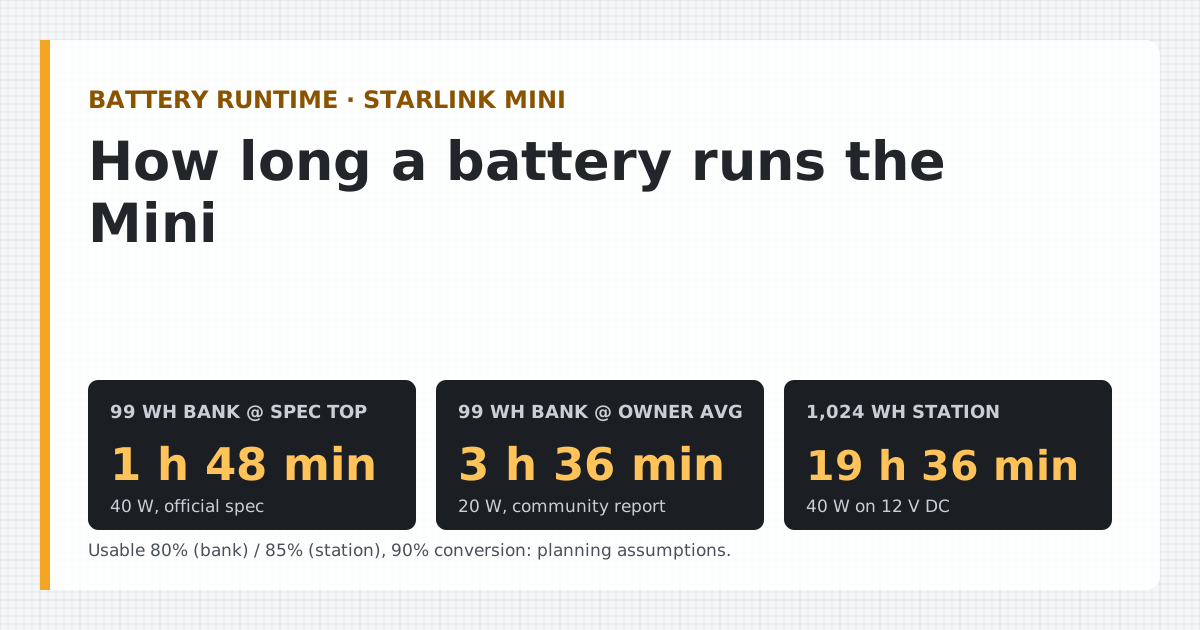
- At the top of Starlink's average range (40 W Official spec: From a Starlink specification sheet or help article. Checked Oct 5, 2026) a 99 Wh USB-C bank gives about 1 h 48 min; at one owner's 3-hour average (20 W Community report: A dated measurement posted by an owner, cited. Checked Oct 5, 2026) about 3 h 36 min.
- A 512 Wh power station on its 12 V or USB-C port covers a 10-hour workday at the spec's top figure (9 h 48 min); a 99 Wh bank does not.
- Seller runtime claims usually skip conversion losses. Divide their Wh by their watts, then take our losses off before you compare.
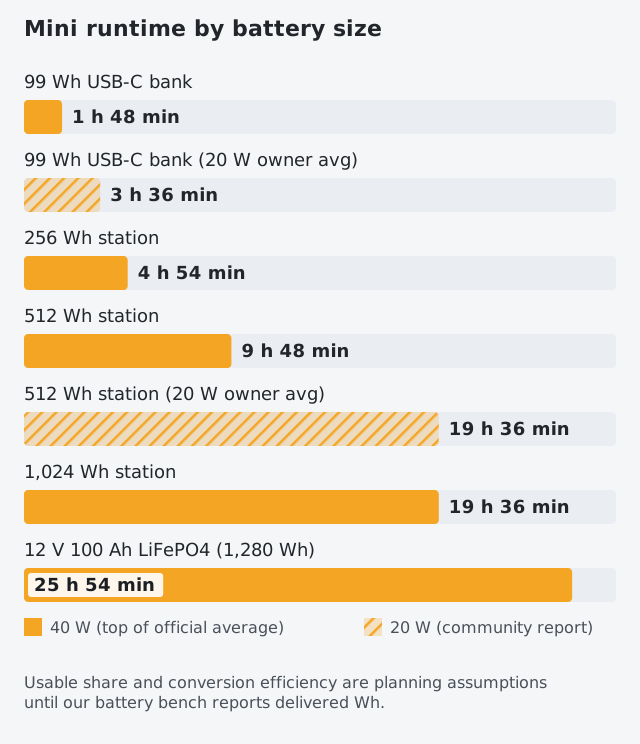
A Starlink Mini runs about 1 h 48 min on a 99 Wh USB-C power bank, 4 h 54 min on a 256 Wh power station, 9 h 48 min on a 512 Wh station and 19 h 36 min on a 1,024 Wh station, if it draws the top of Starlink’s average range, 40 W Official spec: From a Starlink specification sheet or help article. Checked Oct 5, 2026. At the lower average some owners measure (20 W Community report: A dated measurement posted by an owner, cited. Checked Oct 5, 2026), double those hours.
The rest of this article shows where those numbers come from, so you can redo them for the battery you own.
The formula
Runtime needs two inputs: the energy that actually reaches the Mini, and the rate the Mini uses it.
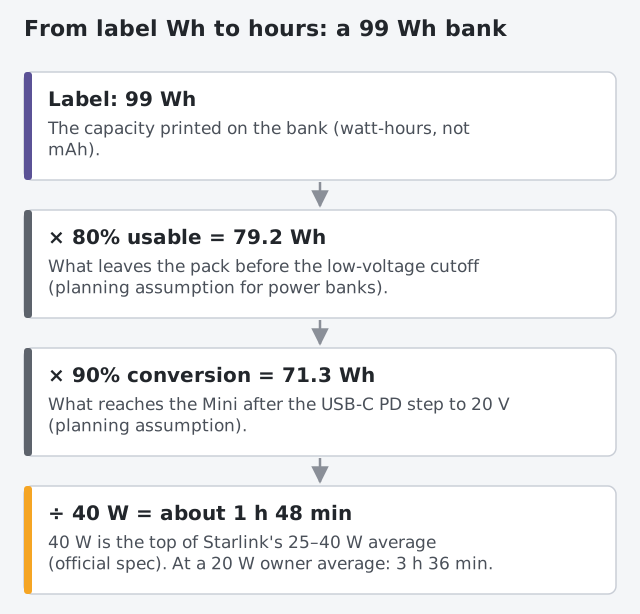
hours = label Wh × usable share × conversion efficiency ÷ Mini watts
- Label Wh (watt-hours) is the capacity printed on the battery. One watt for one hour is one Wh. If the label only shows mAh, convert it first: our power basics guide shows how.
- Usable share is the part of the label you can draw out before the battery’s low-voltage cutoff stops it, after the losses inside the pack. We plan with 80% for USB-C power banks, 85% for power stations and 90% for 12 V LiFePO4 batteries Planning assumption: Our stated assumption, used until bench results replace it. These are our stated assumptions, not measurements; our battery bench will replace them with delivered-Wh results.
- Conversion efficiency is what survives the step from battery voltage to the Mini’s input. On a USB-C PD port or a 12 V DC output we plan with 90%; through a power station’s AC outlet, 87% for the inverter Planning assumption: Our stated assumption, used until bench results replace it.
- Mini watts is the draw while it runs. This is where most runtime math goes wrong.
Which Mini wattage to plan with
Starlink publishes three figures, and owners have posted several more. They answer different questions.
| Figure | Value | What it means |
|---|---|---|
| Average (spec sheet) | 25–40 W Official spec: From a Starlink specification sheet or help article. Checked Oct 5, 2026 | Typical use. Starlink says its figures include the power supply and cables and are AC-input averages. |
| Average (help center) | 20–40 W Official spec: From a Starlink specification sheet or help article. Checked Oct 5, 2026 | Same idea; the help article’s low end is lower than the spec sheet’s. |
| Idle | 15 W Official spec: From a Starlink specification sheet or help article. Checked Oct 5, 2026 | Connected, little traffic. |
| Input rating | 60 W Official spec: From a Starlink specification sheet or help article. Checked Oct 5, 2026 | The most the Mini is rated to take: boot, snow melt, heavy load. Not a typical draw. |
| Owner, 3 h mixed use (USB-C meter) | 20 W Community report: A dated measurement posted by an owner, cited. Checked Oct 5, 2026 | One owner’s average, 64 Wh over 3 h 6 min of browsing and streaming. |
| Owner van log, 24/7 (12 V DC) | 20.3 W Community report: A dated measurement posted by an owner, cited. Checked Oct 5, 2026 | A day average from a logged 486 Wh/day, left on 24/7. |
Plan with the top of the official average (40 W Official spec: From a Starlink specification sheet or help article. Checked Oct 5, 2026) if running out would cost you something: a work call, an emergency message, a game you promised to stream. Use an owner average (around 20 W) only for a best-case estimate, and only after you have checked your own use with a USB-C meter.
The Mini is cheaper to run than the numbers on a spec sheet suggest in light use, and more expensive than the owner averages when it boots, melts snow or works hard in the heat. The watts table lists every reading with its source and date.
Worked example: a 99 Wh power bank
A 99 Wh bank is the biggest power bank you can carry onto a US flight without airline approval (100 Wh Standard: From a regulator, standards body or reference table. Checked Oct 5, 2026 limit per battery), so it’s the most common Mini battery. It needs a single USB-C port rated 100 W (20 V / 5 A); Starlink says sources of 65 W or less won’t run the Mini.
- Label: 99 Wh.
- Usable: 99 × 80% = 79.2 Wh.
- Reaching the Mini: 79.2 × 90% = 71.3 Wh.
- At 40 W: 71.3 ÷ 40 = about 1 h 48 min.
- At the owner average 20 W: about 3 h 36 min. At the idle figure (15 W): about 4 h 48 min.
Cross-check against a field test. CascadiaLink ran a Mini on a 92.5 Wh, 100 W bank and reported CascadiaLink: an INIU 25,000 mAh (92.5 Wh) 100 W power bank ran the Mini about four hours at idle and at least three hours with streaming/calls. Community report: A dated measurement posted by an owner, cited. Checked Oct 5, 2026 If our 80% and 90% assumptions hold, four hours means the Mini averaged about 16.7 W in that test, which sits right next to Starlink’s 15 W idle figure. That’s consistent; it isn’t proof, because one test can’t separate the bank’s delivery from the Mini’s draw.
Runtime by battery size
| Battery (label) | Usable Wh Planning assumption: Our stated assumption, used until bench results replace it | At 40 W | At 20 W |
|---|---|---|---|
| 99 Wh USB-C power bank | 79.2 | 1 h 48 min | 3 h 36 min |
| 256 Wh power station | 217.6 | 4 h 54 min | 9 h 48 min |
| 512 Wh power station | 435.2 | 9 h 48 min | 19 h 36 min |
| 1,024 Wh power station | 870.4 | 19 h 36 min | 39 h 12 min |
| 12 V 100 Ah LiFePO4 (1,280 Wh) | 1,152 | 25 h 54 min | 2.2 days |
These are classes, not brands. We don’t name models until our bench has measured what they actually deliver. The battery guide turns this table into “smallest battery for your hours”.
The AC outlet costs you a little more
If you plug the Mini’s own power supply into a power station’s AC outlet, the station’s inverter turns battery DC into 120 V AC, and the Mini’s supply turns it back to DC. Starlink’s average figures are already measured at the AC input, so we only add the inverter step: 87% instead of 90% Planning assumption: Our stated assumption, used until bench results replace it. On a 1,024 Wh station that is 18 h 54 min instead of 19 h 36 min.
That gap looks small because our planning figure for the inverter is generous. Real inverters also draw power just for being switched on, which matters most at a small load like the Mini. The inverter vs DC guide covers idle draw; the short version is: use the USB-C PD or 12 V port when the station has one that meets the Mini’s input.
How to read a seller’s runtime claim
Sellers publish runtimes too. They’re useful, if you know what they assumed.
- CTMods says its 99 Wh bank runs the Mini CTMods marketing: its 99 Wh bank runs the Mini 5-6+ hours at 20-25 W (about 3.2 h at 40 W). Vendor claim: A seller’s marketing figure, not tested by us. Checked Oct 5, 2026 99 ÷ 20 = 5 hours, which matches the claim only if nothing is lost. With our planning losses, the same 20 W gives about 3 h 36 min.
- Anker SOLIX writes that Anker SOLIX marketing: a 1,000 Wh station could theoretically run a 30 W Mini about 33 hours before conversion losses. Vendor claim: A seller’s marketing figure, not tested by us. Checked Oct 5, 2026 To its credit, it says “before conversion losses”. With our losses the same 1,000 Wh at 30 W comes to about 25.5 hours, not 33.3.
- EcoFlow says EcoFlow marketing: a River 3 Plus could run the Mini for about 8 hours, assuming 30 W. Vendor claim: A seller’s marketing figure, not tested by us. Checked Oct 5, 2026
The test is always the same: divide the claim’s Wh by its watts. If the answer equals the claimed hours, the claim ignores losses. Then check which watt figure it used; 20–30 W is a light-use assumption.
Common mistakes
- Using mAh as if it were Wh. A “27,000 mAh” label is measured at the cell’s voltage, not at 20 V. Convert to Wh before you do anything else.
- Planning with the idle figure. 15 W is what the Mini draws doing almost nothing. Video calls and streaming sit higher; see does streaming drain it faster.
- Forgetting the boot. One owner logged 36–39 W Community report: A dated measurement posted by an owner, cited. Checked Oct 5, 2026 for the first 3–5 minutes after a cold start. If you power it up several times a day, count it. More in startup draw.
- Buying a bank with a 65 W port. It won’t negotiate the 20 V / 5 A profile the Mini needs, however big the battery is. See what “PD 100W” means.
- Ignoring cold. Lithium batteries deliver less when cold, and most shouldn’t be charged below freezing. See charging LiFePO4 below freezing.
What we don’t know yet
We haven’t run the Mini ourselves, and our battery bench hasn’t produced results yet. So the usable share and conversion figures above are planning assumptions, shown with that label. Starlink doesn’t publish the Mini’s draw by connection type, so we can’t tell you exactly how much more efficient the 12 V path is than USB-C. When bench results arrive, every number on this page updates from the data, and the change is logged on our corrections page.
What to do next
- Write down how many hours you need, then add a reserve (a quarter more is a sensible start).
- Pick the watt figure that matches your use: the spec’s top for work and streaming, an owner average only for light use.
- Put both into the runtime calculator, which runs this formula with your battery and hours and tells you the smallest battery class that covers it.
- For overnight use, read running the Mini overnight on a battery before you buy.
Questions people ask
How long does a Starlink Mini last on a 100 W power bank?
A 99 Wh bank with a 100 W USB-C port runs it roughly 1 h 48 min at the top of Starlink's average range and about 3 h 36 min at a 20 W owner-measured average. A bank whose USB-C port is 65 W or less won't run it at all.
How many hours will a 1,000 Wh power station run a Starlink Mini?
About 19 h 36 min at the top of Starlink's average range, on the station's 12 V or USB-C port, and about 39 h 12 min at a 20 W owner-measured average. Through the AC outlet and the Mini's own power supply, expect a little less.
How many watts does the Starlink Mini use?
Starlink's spec sheet lists an average of 25–40 W and its help center lists an idle figure of 15 W. Starlink says those figures include the power supply and cables and are AC-input averages.
Why does my battery run out sooner than the math says?
Three usual reasons: the battery delivers less than its label (cold, age, the low-voltage cutoff), the Mini draws more than you planned (boot, heavy use, snow melt, heat), or you're using the AC outlet, which adds an inverter loss. Plan with the top of the range and keep a reserve.
Is it better to run the Mini from the AC outlet or USB-C on a power station?
Use the USB-C PD port (100 W, 20 V / 5 A) or a 12 V DC output when the station has one. The AC outlet adds the station's inverter loss before the Mini's own power supply. See inverter vs DC.
Does the Starlink Mini have a built-in battery?
No. Starlink lists only power inputs for the Mini (12–48 V DC and USB-C PD with its cable). It needs an outside source the whole time it runs.
Sources
- Starlink Mini Specifications (PDF) · retrieved
- How much power does my Starlink need? (Starlink Help Center) · retrieved
- What USB power rating do I need to power my Starlink Mini? (Starlink Help Center) · retrieved
- StarLink Mini measured power consumption (Escape Trailer Owners forum) · retrieved
- INIU 100W Power Bank: Starlink Mini Field Test (CascadiaLink) · retrieved
- CTMods Starlink Mini Power Bank 99Wh product page · retrieved
- Starlink Mini Power Consumption: 2026 Battery Guide (Anker SOLIX blog) · retrieved
Starlink figures render from our watts table and fact file with the date we checked them. Runtime and solar math uses the planning assumptions on how we get our numbers until bench results replace them.
Independent · not affiliated with SpaceX or Starlink. We don’t sell Starlink. Links to Starlink’s plan pages here use the site owner’s own referral link (Starlink may give the owner a referral reward; your price is the same); nothing else in this article earns us anything. We haven’t used a Starlink Mini ourselves: Mini figures come from Starlink’s published specs or dated owner reports, labeled that way. General information, not electrical advice. How we make money · Report an error