News
FAA safety alert tells airlines to keep passengers’ lithium batteries visible
- Event date
- Effective
- Not stated by the source as of Oct 6, 2026
- Published
- Last updated
Background. This event is more than 90 days old. We keep it for reference; it is not current news.
What changed at a glance
| Item | Before | Now | Source date |
|---|---|---|---|
| FAA guidance to airlines on passengers' lithium batteries | Earlier FAA lithium battery guidance | SAFO 25002: assess batteries stowed out of sight; keep them visible and accessible |
What changed
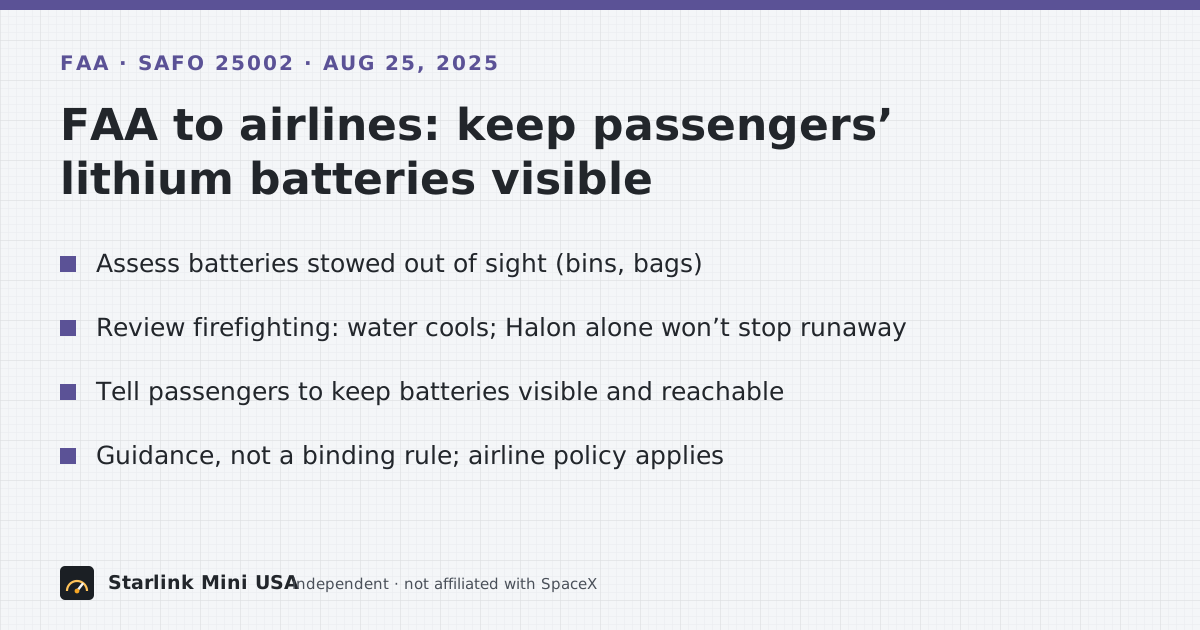
The Federal Aviation Administration issued Safety Alert for Operators (SAFO) 25002, dated August 25, 2025, titled “Managing the Risks of Lithium Batteries Carried by Passengers and Crewmembers.” A SAFO is guidance for airlines. The document itself says it is not legally binding and that following it is voluntary. It is still the FAA’s clearest statement of how it wants airlines to handle power banks in the cabin, and airline policies since then have followed the same direction.
The SAFO’s starting point is that batteries out of sight are a problem. In its words, lithium batteries in overhead bins or carry-on bags “may be obscured, difficult to access, or not readily monitored by passengers or crewmembers.” Its recommendations to airlines include:
- In their safety risk assessments, consider batteries stowed where they aren’t visible or easy to reach, such as overhead bins and carry-on bags.
- Review lithium battery firefighting procedures and training. The SAFO notes that Halon extinguishers can briefly knock down flames but don’t stop thermal runaway, and that the main response is large amounts of water to cool the battery.
- Update passenger messaging: explain what lithium batteries are and how thermal runaway happens, tell passengers to carry batteries where a problem would be visible and reachable, explain how to prevent short circuits, and tell passengers to alert crew right away if a battery overheats.
The SAFO names power banks and portable chargers specifically as lithium batteries that can act as ignition sources.
Who it affects
Directly, US airlines. Indirectly, anyone flying with a power bank, because airlines turned this guidance into rules. Southwest had already required power banks in use to be visible from May 28, 2025 (our post); ICAO’s two-bank limit followed on March 27, 2026 (our post).
For Mini owners, it matters if you fly with the high-output USB-C bank you use to run the dish at your destination.
What it means for your power setup
The SAFO doesn’t change the watt-hour limits. The FAA’s rules for passengers still apply: spare lithium batteries, power banks included, go in carry-on bags only, and lithium-ion batteries are limited to 100 Wh each without airline approval. Those values render from our data file below.
What changes is where your bank should be during the flight: somewhere you can see and reach it, not buried in an overhead bin. Keep the bank’s ports covered or in a pouch so nothing shorts them, which is also the SAFO’s advice. Our USB-C power bank guide covers banks under 100 Wh that can run a Mini; the batteries hub covers alternatives; Mini cases covers packing the dish itself.
What to do
- Carry power banks in your carry-on or personal item, never in checked bags.
- Keep them where you can see and reach them during the flight; follow your airline’s specific rule.
- Protect the terminals: a case, a pouch or taped ports.
- If a bank gets hot, swells, smokes or smells, tell a flight attendant immediately.
What stays the same
- FAA watt-hour limits and the carry-on-only rule: unchanged by this SAFO.
- The SAFO is guidance; airline rules are what you’re held to at the gate.
What we don’t know yet
- Whether the FAA will turn any of this into a binding rule. We don’t predict; we’ll report it if the FAA publishes one.
Values from our data files
These render from the site’s fact store, with where each came from and when we checked it.
- FAA: spare lithium batteries, including power banks, must go in carry-on baggage only. Standard: From a regulator, standards body or reference table. Checked Oct 5, 2026 (checked )
- FAA: lithium-ion batteries are limited to 100 Wh per battery without approval. Standard: From a regulator, standards body or reference table. Checked Oct 5, 2026 (checked )
Source
- FAA: SAFO 25002, Managing the Risks of Lithium Batteries Carried by Passengers and Crewmembers (PDF) (Primary source; source dated ; retrieved )
- FAA: Lithium Battery Resources (incident data and passenger guidance) (Primary source; source dated ; retrieved )
SAFO 25002 points here for the FAA's regularly updated lithium battery incident data.
Update notes
No updates since publication.
Corrections
No corrections since publication. Spotted an error? Tell us.