News
Southwest requires power banks to stay in plain sight while in use
- Event date
- Effective
- Published
- Last updated
Background. This event is more than 90 days old. We keep it for reference; it is not current news.
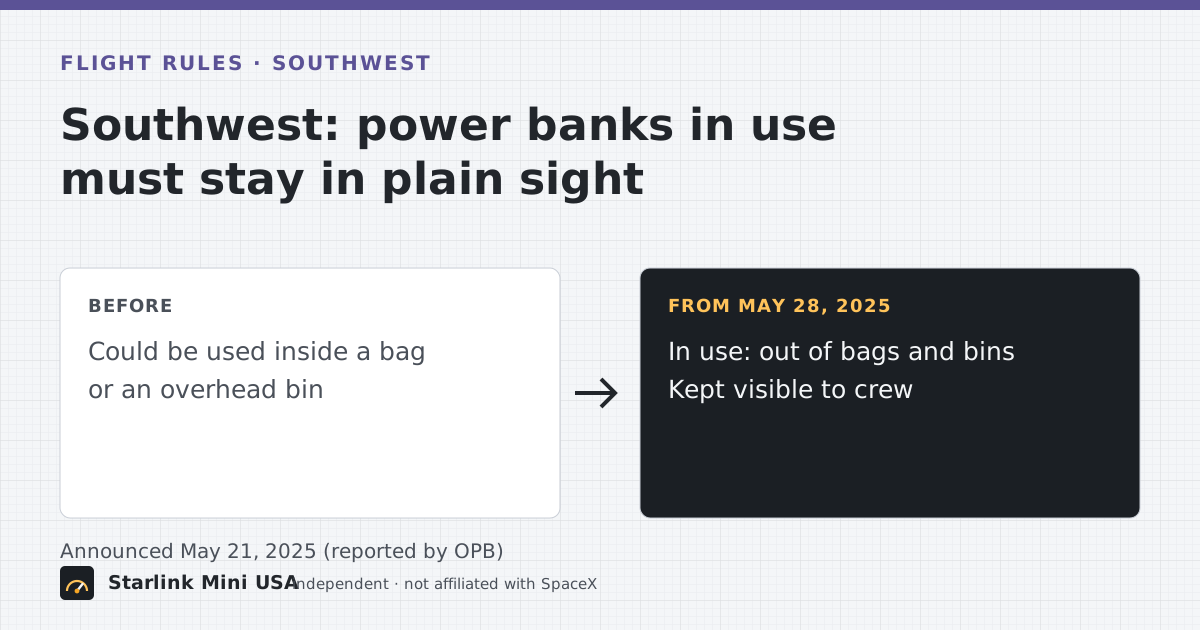
What changed at a glance
| Item | Before | Now | Source date |
|---|---|---|---|
| Using a power bank on a Southwest flight | Allowed while stored in a bag or overhead bin | Must be out of bags and bins and kept visible while in use |
What changed
Southwest Airlines announced on May 21, 2025 that, starting May 28, 2025, passengers using a portable charger or power bank on board must keep it in plain sight. Using a power bank while it’s inside a bag or an overhead bin is no longer allowed. OPB’s report described it as a “first-in-industry” policy at the time and quoted Southwest:
“Using portable charging devices while stored in a bag or overhead bin will no longer be permitted.”
The reason given is speed: a battery that’s visible can be spotted and dealt with sooner if it starts to overheat. OPB noted that the FAA had recorded at least 22 lithium battery incidents on flights in 2025 by that point, and that other airlines and countries had tightened rules after the January 2025 Air Busan fire.
Who it affects
Southwest passengers who use a power bank during a flight. The rule is about use. It didn’t, at the time, limit how many banks you could carry; Southwest added a one-bank limit later, from April 20, 2026 (our post).
For Mini owners, the overlap is the high-output USB-C bank many people carry to run the dish at the destination. Those banks are often the biggest battery in a carry-on.
What it means for your power setup
This was the first of several rule changes in a year, and the direction has been consistent: fewer power banks, kept in sight, not charged on board. The FAA’s August 2025 safety alert to airlines made the same point about visibility (our post), and ICAO’s March 2026 change set a two-bank limit and banned recharging banks on board.
If you’re flying to use a Mini, the simplest plan is to land with your bank fully charged and not use it in flight. That keeps you clear of the use rules, and it means the bank’s full capacity is there for the dish. Our USB-C power bank guide covers banks under 100 Wh that can run a Mini, and the best battery for a Mini covers other options. For packing the dish, see Mini cases.
What to do
- If you use a power bank on a Southwest flight, keep it out of your bag and in view.
- Don’t use a power bank while it’s in an overhead bin, on any airline.
- Check Southwest’s current lithium battery page before you fly; the rules have changed since this announcement.
What stays the same
- Power banks remain banned from checked bags, per the FAA.
- The FAA’s watt-hour limits for spare lithium batteries: unchanged by this policy.
- Starlink’s power requirements for the Mini: unchanged.
What we don’t know yet
- Southwest’s original announcement text. We read it as quoted by OPB; Southwest’s current help pages show today’s rules, not the May 2025 wording.
- How Southwest enforced the visibility rule in practice. The report doesn’t say.
Values from our data files
These render from the site’s fact store, with where each came from and when we checked it.
- FAA: spare lithium batteries, including power banks, must go in carry-on baggage only. Standard: From a regulator, standards body or reference table. Checked Oct 5, 2026 (checked )
Source
- OPB (Oregon Public Broadcasting): Southwest Airlines will require passengers to keep chargers visible due to fire risk (Secondary source; source dated ; retrieved )
- Southwest Airlines: Hazardous Materials (support article) (Primary source; source dated ; retrieved )
Current Southwest page; confirms power banks are banned from checked bags and links to Southwest's lithium battery rules. It does not show the May 2025 announcement itself.
Update notes
No updates since publication.
Corrections
No corrections since publication. Spotted an error? Tell us.