Key takeaways
- Panel watts = daily Wh from the battery ÷ (peak sun hours × 0.75). The 75% factor is our planning allowance for heat, dirt, angle and charging losses Planning assumption: Our stated assumption, used until bench results replace it.
- A 10-hour Mini workday at the top of Starlink's range (40 W) takes about 444 Wh from the battery.
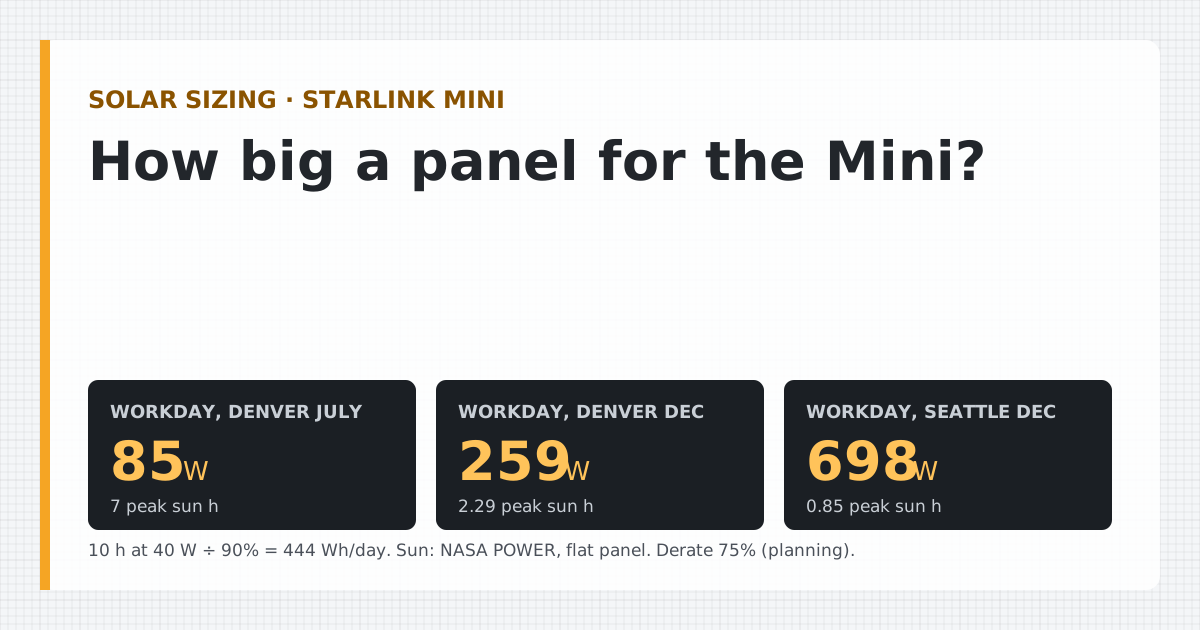
- In Denver that needs about 85 W of panel in July but 259 W in December. In Seattle in December, about 698 W.
- Size for your worst month, not the year's average. Sun hours come from NASA POWER's 20-year climatology for one reference city per state, on a flat panel.
- The panel only replaces the day's energy. You still need a battery big enough for the hours the sun isn't up, plus cloudy days.
For a Starlink Mini, panel watts = the Mini’s daily watt-hours from the battery ÷ (your worst month’s peak sun hours × 0.75). A 10-hour workday at the top of Starlink’s average range takes about 444 Wh, so in Denver you need about 85 W of panel in July and 259 W in December; in Seattle in December, about 698 W. The month you size for changes the answer more than anything else.
Number 1: watt-hours per day, at the battery
Start with what the Mini actually takes out of the battery each day:
daily Wh = Mini watts × hours on ÷ conversion efficiency
- Mini watts: plan with the top of Starlink’s average, 40 W Official spec: From a Starlink specification sheet or help article. Checked Oct 5, 2026, unless you’ve measured your own use.
- Hours on: be honest. A workday is 10 hours; 24/7 is 24.
- Conversion: we plan with 90% on a USB-C or 12 V port Planning assumption: Our stated assumption, used until bench results replace it.
Examples:
| Pattern | Calculation | Daily Wh at the battery |
|---|---|---|
| 10-hour workday at the spec’s top | 10 × 40 W ÷ 90% | 444 Wh |
| Left on 24/7, one owner’s van log | measured on the DC side | 486 Wh/day Community report: A dated measurement posted by an owner, cited. Checked Oct 5, 2026 |
| Same van, off overnight (owner’s estimate) | 486 − 150 | 336 Wh |
The van log (FarOutRide: about 486 Wh per day when left on 24/7; switching it off overnight would save about 150 Wh/day. Community report: A dated measurement posted by an owner, cited. Checked Oct 5, 2026) is lower per hour than the spec’s top because the Mini spent much of the day near idle. Use it for a best-case 24/7 plan; use the spec figure if you’ll work or stream for hours.
Number 2: peak sun hours in your worst month
A peak sun hour is one hour of sunlight at 1,000 watts per square meter, the brightness panels are rated at. One peak sun hour = 1 kWh/m² of insolation; daily kWh/m² equals peak sun hours because peak irradiance is taken as 1 kW/m². Standard: From a regulator, standards body or reference table. Checked Oct 5, 2026 A day with 4 peak sun hours delivers the same energy as 4 hours at full test brightness, spread across morning to evening.
Our sun hours come from NASA POWER’s 20-year climatology (2001–2020), one reference city per state, on a flat panel. Flat is the conservative case for a portable panel laid on the ground; tilting toward the sun does better, especially in winter.
| City | July | December |
|---|---|---|
| Phoenix | 7.5 | 3.1 |
| Denver | 7 | 2.3 |
| Orlando | 5.7 | 3.1 |
| Seattle | 6.3 | 0.9 |
Every state’s 12 months are on solar sizing by state. Pick the worst month you’ll actually use the Mini in. For a summer-only setup that might be September; for year-round, December almost everywhere.
Number 3: the loss factor
A panel rated 100 W doesn’t deliver 100 W × sun hours to your battery. Heat lowers its output, dust and angle cost more, the charge controller and battery charging lose some. NREL’s PVWatts calculator assumes 14 % Standard: From a regulator, standards body or reference table. Checked Oct 5, 2026 of system losses by default before inverter losses Standard: From a regulator, standards body or reference table, for fixed, well-installed rooftop arrays. Portable panels laid on the ground do worse, so we plan with 75% of nameplate × sun hours reaching the battery Planning assumption: Our stated assumption, used until bench results replace it.
Putting it together
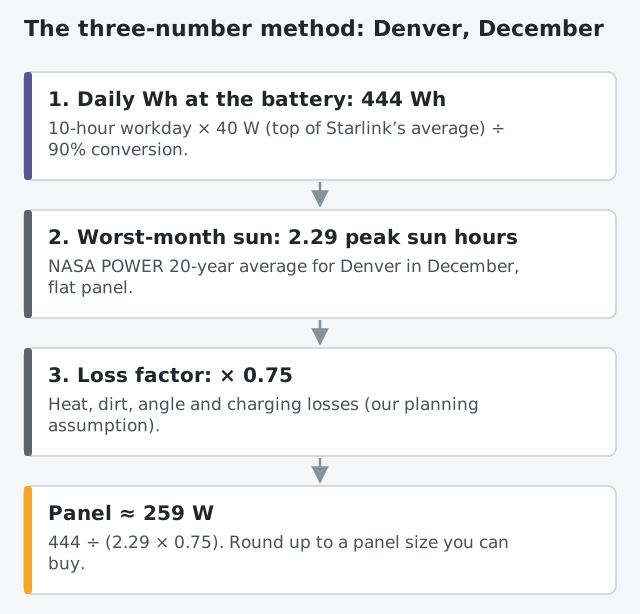
panel watts = daily Wh ÷ (peak sun hours × 0.75)
Workday, Denver, December: 444 ÷ (2.3 × 0.75) ≈ 259 W. Round up to the next panel size you can buy.
| 10-hour workday (444 Wh) | July | December |
|---|---|---|
| Denver | 85 W | 259 W |
| Phoenix | — | 193 W |
| Seattle | — | 698 W |
| Left on 24/7 (486 Wh, owner log) | July | December |
|---|---|---|
| Phoenix | 87 W | 211 W |
| Denver | 93 W | 283 W |
| Orlando | 114 W | 208 W |
| Seattle | 103 W | 763 W |
Two things jump out. Summer sizing is easy in sunny states: around a 100 W portable panel covers a Mini workday in a Denver July. Winter is a different project, and in the cloudy north it’s several times the summer panel. Our July vs December comparison goes state by state.
The battery you still need
The panel replaces the day’s energy; it doesn’t power the Mini at night or under heavy cloud. You need a battery that covers:
- The hours without sun. For a workday that ends at dusk, little. For 24/7 use, the night: see the overnight guide.
- Cloudy days. Off-grid planners call this “days of autonomy”: how many days the battery alone can carry the load. How many you need depends on your local weather and what an outage would cost you. The monthly averages already include typical weather, but not a bad week.
- Cold. In winter, a lithium battery can’t accept charge below its maker’s limit; morning sun may be wasted until it warms. See charging LiFePO4 below freezing.
Match the panel to the battery’s solar input too: a power station lists a maximum solar input in watts and a voltage window. Exceeding the voltage can damage it.
Common mistakes
- Sizing from the annual average. It hides December.
- Using the panel’s rating as its output. Use the 75% factor, or measure.
- Laying the panel flat in winter. Our figures assume flat; tilt it toward the sun and you gain.
- Partial shade. A shadow across a small part of a panel can cut its output far more than the shaded share. Keep it fully in sun.
- Going panel-direct. It drops out with every cloud; see panel with no battery.
What to do next
- Work out your daily Wh at the battery.
- Look up your state’s worst month on solar sizing by state.
- Or let the calculator do both and show the December-versus-July panel watts for your state.
Questions people ask
What size solar panel do I need for a Starlink Mini?
Divide the Mini's daily watt-hours (from the battery) by your worst month's peak sun hours times 0.75. A 10-hour workday (444 Wh) needs about 85 W in a Denver July and 259 W in a Denver December.
Will a 100W solar panel run a Starlink Mini?
In summer in a sunny state, a 100 W panel can roughly replace a workday's energy (about 85 W needed in a Denver July). It can't run the Mini through clouds or at night without a battery, and in December almost anywhere it falls well short.
How many solar panels to run Starlink Mini 24/7?
At one owner's logged 486 Wh/day: about 93 W in a Denver July and 283 W in a Denver December; in Seattle in December about 763 W. Plus a battery for nights and cloudy spells.
What are peak sun hours?
The day's total sunlight expressed as hours of full-strength (1,000 W per square meter) sun. 4 peak sun hours means the panel gets as much energy as 4 hours at its rated test brightness, spread across the whole day.
Can I connect a solar panel directly to the Starlink Mini?
Not reliably. A panel's output drops whenever a cloud passes, and the Mini needs a steady 12–48 V supply. Run the panel into a battery or power station and the Mini from that. See panel with no battery.
Should I tilt my portable panel?
Yes, toward the sun, especially in winter. Our sun-hour figures are for a flat panel, the conservative case, so tilting usually beats them.
Sources
- NASA POWER Climatology API (ALLSKY_SFC_SW_DWN, 2001–2020) · retrieved
- Average Solar Radiation - Peak Sun Hours (PVEducation) · retrieved
- PVWatts Version 5 Manual (NREL) · retrieved
- Starlink Mini Specifications (PDF) · retrieved
- Starlink Mini Install: Power, Wiring, & Mounting to our Van (FarOutRide) · retrieved
Starlink figures render from our watts table and fact file with the date we checked them. Runtime and solar math uses the planning assumptions on how we get our numbers until bench results replace them.
Independent · not affiliated with SpaceX or Starlink. We don’t sell Starlink. Links to Starlink’s plan pages here use the site owner’s own referral link (Starlink may give the owner a referral reward; your price is the same); nothing else in this article earns us anything. We haven’t used a Starlink Mini ourselves: Mini figures come from Starlink’s published specs or dated owner reports, labeled that way. General information, not electrical advice. How we make money · Report an error