Key takeaways
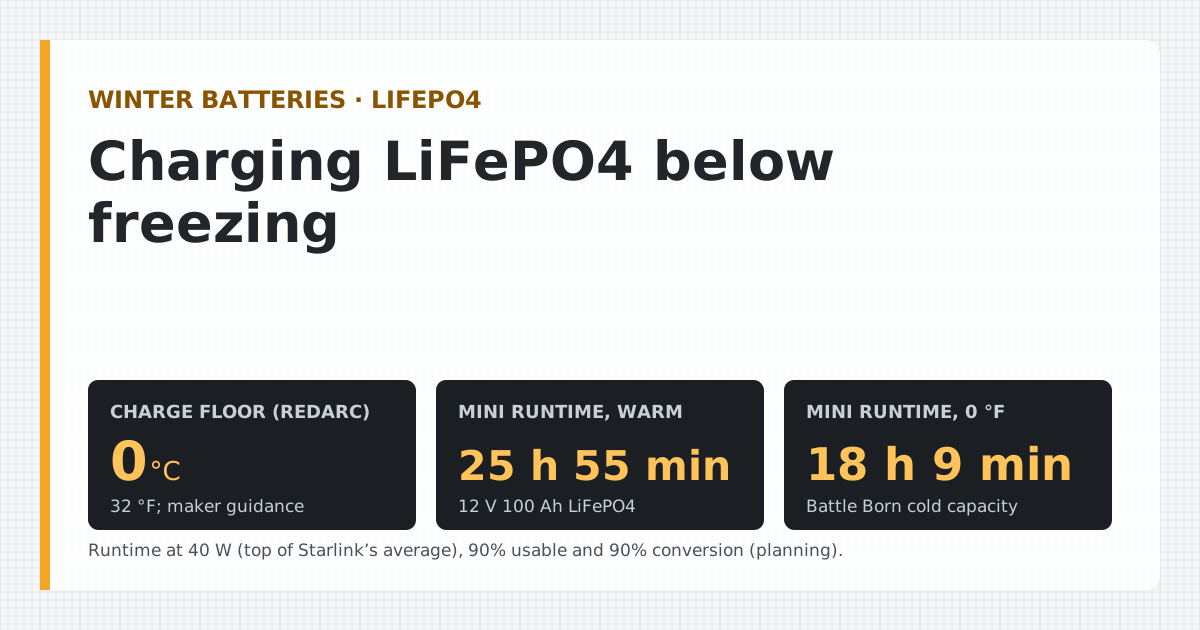
- Don't charge LiFePO4 below freezing unless the battery is built for it. REDARC: 0 °C is the floor; Renogy's protected batteries cut charging at 32 °F; Battle Born's block it below an internal 24 °F.
- Discharging in the cold is allowed but delivers less: Battle Born says a 100 Ah battery gives about 80 Ah at 32 °F and 70 Ah at 0 °F, recoverable when warm.
- On a 12 V 100 Ah LiFePO4, that's about 25 h 55 min of Mini runtime warm, 20 h 44 min at 32 °F and 18 h 9 min at 0 °F, at the top of Starlink's range.
- The Mini itself is rated to -22 °F Official spec: From a Starlink specification sheet or help article. Checked Oct 5, 2026. The battery, not the dish, is usually the winter weak point.
- Fixes: keep the battery inside the heated or insulated space, use a self-heating battery, or let the charger's low-temperature cutoff do its job and plan for lost morning sun.
Don’t charge a LiFePO4 battery below freezing unless it’s built for it. REDARC says charging below 0 °C Standard: From a regulator, standards body or reference table. Checked Oct 5, 2026 must be avoided; Renogy’s low-temperature-protected batteries cut off charging at 32 °F Standard: From a regulator, standards body or reference table. Checked Oct 5, 2026; Battle Born’s block charging below an internal 24 °F Standard: From a regulator, standards body or reference table. Checked Oct 5, 2026. For a winter Starlink setup, that means morning sun can be wasted until the battery warms, and a battery left in the cold delivers less: a 12 V 100 Ah LiFePO4 runs a Mini about 25 h 55 min warm but about 18 h 9 min at 0 °F.
What the makers say
| Maker | Charging in the cold | Capacity in the cold |
|---|---|---|
| REDARC | REDARC: charging LiFePO4 below 0 C (32 F) must be avoided (lithium plating); best charging range 5-45 C. Standard: From a regulator, standards body or reference table. Checked Oct 5, 2026 | — |
| Renogy | Renogy: LiFePO4 should not be charged below 32 F (0 C) unless self-heating; its low-temp-protection batteries cut off charging at 32 F. Standard: From a regulator, standards body or reference table. Checked Oct 5, 2026 | Renogy: at 32 F most batteries deliver about 70-80% of rated capacity; at 0 F about 45-50%. Standard: From a regulator, standards body or reference table. Checked Oct 5, 2026 |
| Battle Born | Battle Born batteries block charging below an internal temperature of 24 F (lithium plating risk). Standard: From a regulator, standards body or reference table. Checked Oct 5, 2026 | Battle Born: at 32 F a 100 Ah battery delivers about 80 Ah; at 0 F about 70 Ah (recoverable when warm). Standard: From a regulator, standards body or reference table. Checked Oct 5, 2026 |
Three makers, one message: charging is the dangerous part, discharging is allowed with less capacity. The reason makers give is lithium plating. When a cold cell is pushed to accept charge, lithium can deposit as metal on the anode instead of moving into it, which permanently costs capacity and can damage the cell. Many batteries’ management systems refuse charge below the limit for exactly this reason.
These are each maker’s figures for its own batteries. Yours may differ; its manual or spec sheet is the authority. Note too that the limits are about the battery’s internal temperature, which lags the air: a battery that spent the night at 10 °F stays cold for a while after the sun comes up.
What cold does to Mini runtime
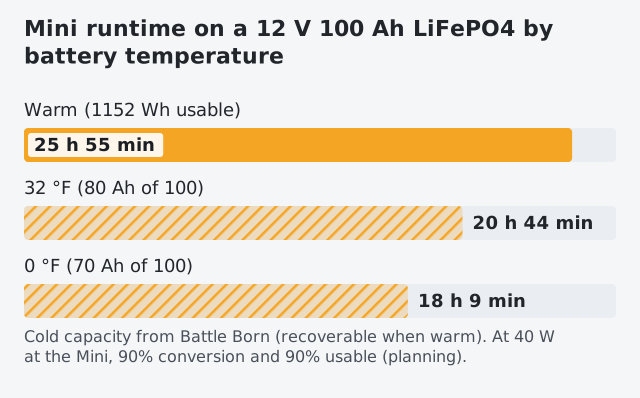
Battle Born gives its cold-capacity figures for a 100 Ah battery: Battle Born: at 32 F a 100 Ah battery delivers about 80 Ah; at 0 F about 70 Ah (recoverable when warm). Apply them to a 12 V 100 Ah LiFePO4 (1,280 Wh label), using our 90% usable planning figure and the Mini at the top of Starlink’s average range (40 W Official spec: From a Starlink specification sheet or help article. Checked Oct 5, 2026, 44.4 W at the battery after 90% conversion Planning assumption: Our stated assumption, used until bench results replace it):
| Battery temperature | Usable Wh | Mini runtime |
|---|---|---|
| Warm | 1,152 | 25 h 55 min |
| 32 °F | 922 | 20 h 44 min |
| 0 °F | 806 | 18 h 9 min |
At an owner-measured 20 W average the 0 °F runtime is about 36 h 17 min. Battle Born says the lost capacity comes back when the battery warms; it isn’t damage, it’s chemistry slowing down.
The dish is tougher than the battery
Starlink rates the Mini to run from -22 °F Official spec: From a Starlink specification sheet or help article. Checked Oct 5, 2026 to 122 °F Official spec: From a Starlink specification sheet or help article. Checked Oct 5, 2026 and to melt 1 in/hr Official spec: From a Starlink specification sheet or help article. Checked Oct 5, 2026 of snowfall. Starlink’s general weather article adds that Starlink says the router and power supply are also rated to operate indoors between 0 and +30°C (+32 to +86°F).
So in a cold snap the Mini on the roof is inside its rating while the battery in an unheated compartment is below its charging limit. A setup that “worked fine in October” stops recharging in December, not because the panel or dish failed, but because the battery is protecting itself.
How a cold morning plays out
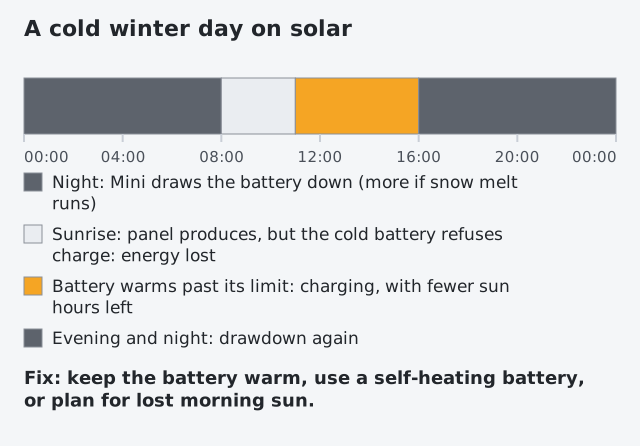
- Overnight, the Mini draws the battery down (more if snow melt runs).
- At sunrise the panel starts producing, but the battery is below its charge limit. Its management system or the charger holds off. That energy is lost.
- Mid-morning the battery warms past the limit (if it’s in a warmer space, or the day warms up) and charging starts, with fewer sun hours left.
- On a short December day, the shortened window may not refill what the night took.
That stacks on top of December’s lower sun hours, which our summer vs winter comparison puts at a fraction of July’s.
Keeping winter solar working
- Move the battery into the warm. Inside the living space of a van, cabin or tent is the cheapest fix. Follow your maker’s installation instructions for where it can live.
- Insulate the battery compartment. It slows overnight cooling; it won’t keep a battery warm for days in deep cold on its own.
- Use a self-heating battery. Renogy describes self-heating batteries that warm the cells before charging. The heater uses some energy, but it lets you use morning sun.
- Let the protection work. If your battery has low-temperature charge protection, trust it. Don’t bypass it to “get charging going”.
- Plan the load for winter. Fewer hours online, off overnight, snow melt only when needed. See the overnight guide.
- Have a backup charge source for the coldest weeks: charging from the grid or a vehicle when the battery is warm.
Power banks and power stations in the cold
The same chemistry applies to the lithium cells inside power banks and stations, whether LiFePO4 or other lithium types. Many stations list a narrower charging temperature range than discharging range in their manual. Bring a power bank inside your jacket or sleeping bag before charging it, and expect less runtime from one that’s been in a cold car.
What we don’t know
We haven’t measured cold capacity on our own bench yet. The figures above are each maker’s statements for its own products, applied with our planning assumptions. Different chemistries and brands behave differently; check yours.
What to do next
Check your battery’s manual for its charge and discharge temperature ranges. Then size winter solar with the three-number method using December sun, and read our winter off-grid guide for snow melt and cold-weather placement.
Questions people ask
Can you charge LiFePO4 below freezing?
Not safely, unless the battery has built-in heating or a maker's approval for it. REDARC says charging LiFePO4 below 0 °C (32 °F) must be avoided because of lithium plating; Renogy says not to charge below 32 °F unless the battery is self-heating.
What happens if you charge a lithium battery below freezing?
Makers warn of lithium plating: metallic lithium forms on the anode instead of being absorbed, which permanently reduces capacity and can damage the cell. That's why many batteries block charging below a set temperature.
Can LiFePO4 batteries be used below freezing?
Discharging is generally allowed, with less capacity. Battle Born says a 100 Ah battery delivers about 80 Ah at 32 °F and about 70 Ah at 0 °F, and the capacity comes back when it warms.
Will my solar charge controller charge a frozen battery?
Many batteries refuse charge themselves through their battery management system below their limit, whatever the controller does. Some chargers also have a temperature sensor. Check both manuals; don't rely on one if you don't know the other.
How cold can the Starlink Mini operate?
Starlink rates the Mini from -22 °F to 122 °F. Starlink's general weather article also rates the router and power supply for indoor use from 32 to 86 °F.
Are self-heating LiFePO4 batteries worth it for winter Starlink?
If the battery has to live somewhere that drops below freezing and you rely on solar, usually yes: the heater uses some of the incoming charge to warm the cells before charging. If the battery can live indoors, insulation and location are cheaper.
Sources
- Why you should not charge a lithium battery below 0C or 32F (REDARC support) · retrieved
- Renogy Self-Heating vs. Low-Temperature Protection Lithium Battery (Renogy blog) · retrieved
- How to Winterize and Store LiFePO4 Batteries (Battle Born FAQ) · retrieved
- Battle Born 100Ah 12V LiFePO4 Deep Cycle Battery product page · retrieved
- Starlink Mini Specifications (PDF) · retrieved
- I live in an area with snow, heavy rain, wind, lightning, or extreme temperatures - can I still use Starlink? (Starlink Help Center) · retrieved
Starlink figures render from our watts table and fact file with the date we checked them. Runtime and solar math uses the planning assumptions on how we get our numbers until bench results replace them.
Independent · not affiliated with SpaceX or Starlink. We don’t sell Starlink. Links to Starlink’s plan pages here use the site owner’s own referral link (Starlink may give the owner a referral reward; your price is the same); nothing else in this article earns us anything. We haven’t used a Starlink Mini ourselves: Mini figures come from Starlink’s published specs or dated owner reports, labeled that way. General information, not electrical advice. How we make money · Report an error