Key takeaways
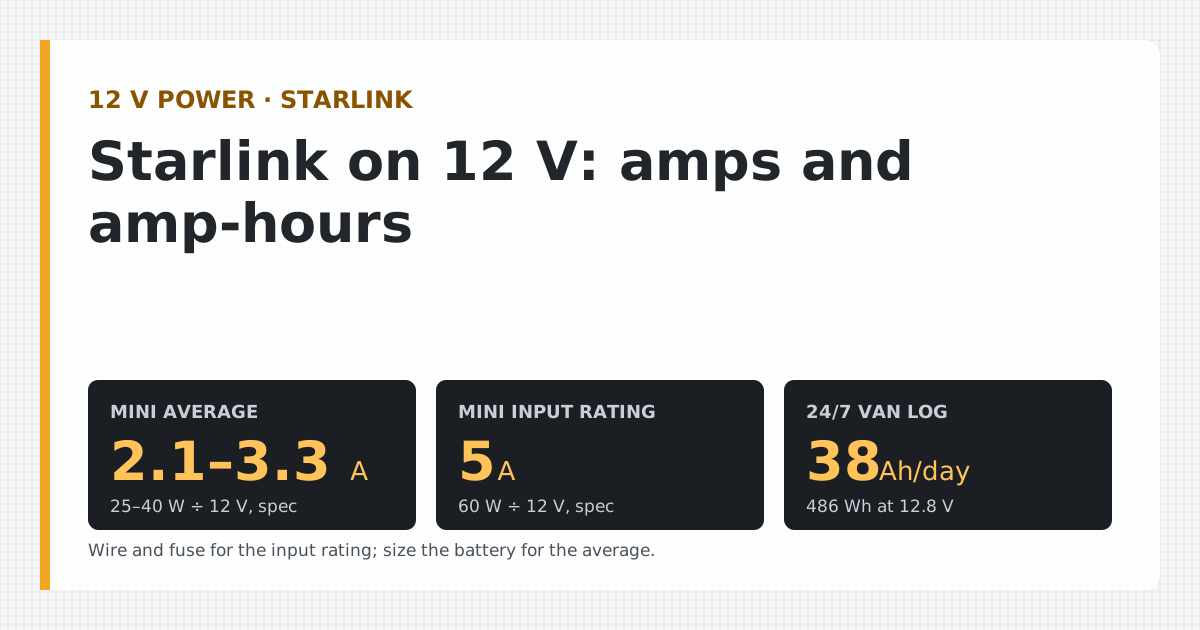
- Amps = watts ÷ volts. Starlink's Mini average of 25–40 W Official spec: From a Starlink specification sheet or help article. Checked Oct 5, 2026 is about 2.1–3.3 A at 12 V; its 60 W input rating is about 5 A.
- One van owner's 12 V log: 18–20 W Community report: A dated measurement posted by an owner, cited. Checked Oct 5, 2026 idle, 39 W Community report: A dated measurement posted by an owner, cited. Checked Oct 5, 2026 in heavy use, 486 Wh/day left on 24/7. At 12.8 V that's about 38 Ah a day.
- The Mini takes 12 V to 48 V DC directly. The Standard needs Starlink's DC-DC power supply (select markets) or an inverter.
- On 12 V, cable length and gauge matter: a 20 ft run of 16 AWG loses about 0.5 V (4.5%) at 40 W; 18 AWG loses 0.9 V.
On a 12 V system a Starlink Mini averages about 2.1–3.3 A (Starlink’s 25–40 W Official spec: From a Starlink specification sheet or help article. Checked Oct 5, 2026 ÷ 12 V), and its 60 W Official spec: From a Starlink specification sheet or help article. Checked Oct 5, 2026 input rating means up to about 5 A to wire for. Left on all day, one van owner logged 486 Wh/day Community report: A dated measurement posted by an owner, cited. Checked Oct 5, 2026, which is about 38 Ah a day from a 12.8 V battery. A Standard dish can’t take 12 V directly; it needs Starlink’s DC-DC power supply or an inverter.
Watts to amps to amp-hours
Starlink publishes watts. 12 V batteries are sold in amp-hours (Ah). The conversions:
amps = watts ÷ volts amp-hours = amps × hours watt-hours = amp-hours × volts
Which voltage? A 12 V lead-acid battery rests a little above 12 V when charged; a 12 V LiFePO4 battery is usually rated at a nominal 12.8 V. For wiring and fuses, divide by 12 (lower voltage means more current, so it’s the safe side). For daily amp-hours from a LiFePO4 battery, divide by 12.8.
One more wrinkle: Starlink says its watt figures are AC-input averages that include the power supply and cables. On a 12 V path the Mini skips its AC supply, but the cable and any converter still lose a little. We plan with 90% on 12 V Planning assumption: Our stated assumption, used until bench results replace it, which turns 40 W at the Mini into about 44.4 W, or 3.7 A, at the battery.
The Mini on 12 V: the numbers
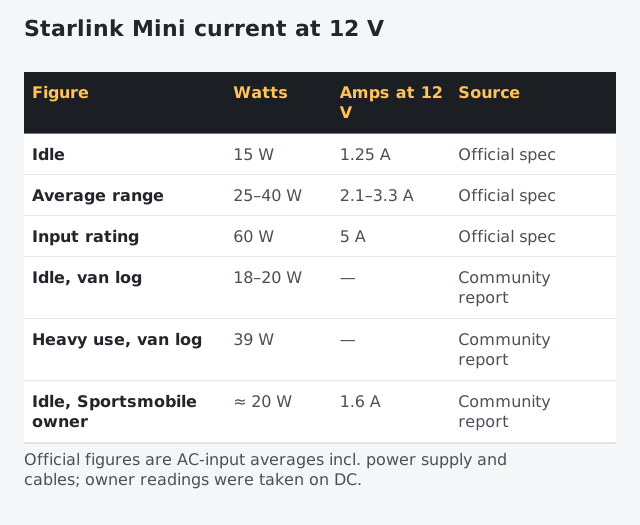
| Figure | Watts | Amps at 12 V |
|---|---|---|
| Idle (Starlink) | 15 W Official spec: From a Starlink specification sheet or help article. Checked Oct 5, 2026 | 1.3 A |
| Average range (Starlink) | 25–40 W Official spec: From a Starlink specification sheet or help article. Checked Oct 5, 2026 | 2.1–3.3 A |
| Input rating (Starlink) | 60 W Official spec: From a Starlink specification sheet or help article. Checked Oct 5, 2026 | 5 A |
| Idle, van log on 12 V | 18–20 W Community report: A dated measurement posted by an owner, cited. Checked Oct 5, 2026 | — |
| Heavy evening use, van log | 39 W Community report: A dated measurement posted by an owner, cited. Checked Oct 5, 2026 | — |
| Idle reading, Sportsmobile owner | ≈ 20 W at 12.8 V | 1.6 A Community report: A dated measurement posted by an owner, cited. Checked Oct 5, 2026 |
The owner readings were taken on real 12 V systems, so they include whatever wiring and converter those owners used. They agree with Starlink’s ranges: teens to low 20s of watts at idle, high 30s in heavy use. Another Sportsmobile owner reports idle in the mid-teens to low 20s W and use in the mid-20s to low 30s W, through a 12V-to-30V converter.
Amp-hours per day
The van log is the best whole-day number we have: FarOutRide: about 486 Wh per day when left on 24/7; switching it off overnight would save about 150 Wh/day. Community report: A dated measurement posted by an owner, cited. Checked Oct 5, 2026
- 486 Wh ÷ 12.8 V ≈ 38 Ah a day, left on 24/7.
- The same owner estimated switching off overnight would save about 150 Wh a day, bringing it to about 336 Wh.
So a 12 V 100 Ah LiFePO4 battery (1,280 Wh) runs a Mini left on around the clock for roughly two days, with no solar. At the top of Starlink’s average range continuously it would be less: about 25 h 54 min at our 90% usable planning figure. Our overnight guide covers the on-or-off-at-night decision.
The Standard dish on 12 V
The Standard dish averages 75–100 W Official spec: From a Starlink specification sheet or help article. Checked Oct 5, 2026 with an idle figure of 20 W Official spec: From a Starlink specification sheet or help article. Checked Oct 5, 2026, and its normal power supply is AC only (The Standard 4 X power supply is AC: 100-240 V, 2.5 A, 50-60 Hz.). Two ways to run it from a 12 V battery:
- Starlink’s DC-DC power supply (sold in select markets): Starlink sells a Standard DC-DC Power Supply (select markets) to run Standard 4 / 4 X from a DC source without an inverter; it uses XT60 connectors and 12 AWG wire. The Standard DC-DC Power Supply accepts 12-48 V DC at up to 30 A and outputs 56 V at 3.57 A. At the top of the Standard’s range and our 90% planning efficiency, that’s about 9.3 A at 12 V, nearly three times the Mini.
- An inverter running the dish’s normal AC supply. Simpler to source, but you pay the inverter’s loss plus its own idle draw; see inverter vs DC.
Older dishes on owner-built 12 V conversions are a different case. Lorjor Explore, running a Gen 2 (Standard Actuated) on a 12 V conversion with a small router, measured 30–40 W Community report: A dated measurement posted by an owner, cited. Checked Oct 5, 2026 on average and saw up to 45 W Community report: A dated measurement posted by an owner, cited. Checked Oct 5, 2026 with snow melt on in the app. That’s useful history, but it’s not the current Standard and it’s a modified system.
Wire for the current, not the average
At 12 V, current is high enough that the cable matters. Copper resistance is fixed per foot, and the voltage you lose is current × resistance, counted both ways (out and back). For a 20-foot run at the top of the Mini’s average range (40 W, 3.3 A) using standard resistance figures Standard: From a regulator, standards body or reference table:
| Gauge | Ohms per 1,000 ft | Voltage lost | Share of 12 V |
|---|---|---|---|
| 18 AWG | 6.39 ohm/1000 ft | 0.9 V | 7.1% |
| 16 AWG | 4.02 ohm/1000 ft | 0.5 V | 4.5% |
| 14 AWG | 2.53 ohm/1000 ft | 0.3 V | 2.8% |
| 12 AWG | 1.59 ohm/1000 ft | 0.2 V | 1.8% |
At boot and at the 60 W rating the current, and the loss, are higher. Starlink’s own advice for 12 V trouble: Starlink's Mini setup guide says that if a 12 V supply or battery causes issues, use a shorter or thicker-gauge cable, supply a higher voltage, or use the USB-C cable with a 100 W supply or the Car Adapter. Our 12 V guide has a fuller table, and startup draw explains why marginal wiring fails at boot first.
USB-C versus 12 V DC for the Mini
Many 12 V systems also have a 100 W USB-C PD port (on a power station, or a 12 V to USB-C PD adapter). Either path works if it meets the Mini’s input:
- 12 V DC to the barrel jack: fewest parts; mind gauge and length.
- USB-C PD at 20 V / 5 A with Starlink’s USB-C cable: needs a source of at least 100 W Official spec: From a Starlink specification sheet or help article. Checked Oct 5, 2026. Higher voltage means less current in the cable, so less drop; but the cable is only 5 m Official spec: From a Starlink specification sheet or help article. Checked Oct 5, 2026 and its USB-C end shouldn’t be outdoors.
Starlink doesn’t publish the Mini’s draw by connection type, so we can’t say which path is more efficient in practice. We plan both at 90%.
What to do next
- Wire and fuse for 5 A; budget the battery at the average.
- Convert your daily hours to amp-hours with the formula above, or let the calculator do it.
- For a car’s accessory socket specifically, see can a cigarette lighter socket run the Mini.
Questions people ask
How many amps does Starlink Mini draw at 12V?
On average about 2.1–3.3 A, from Starlink's 25–40 W average range. Its input rating of 60 W works out to 5 A at 12 V, the most to plan wiring and fuses around.
How many amp-hours does Starlink Mini use per day?
One van owner logged 486 Wh/day left on 24/7, about 38 Ah at a 12.8 V LiFePO4 battery's nominal voltage. Turning it off overnight cut about 150 Wh a day by the owner's estimate.
Can Starlink run on 12V?
The Mini can, directly: it accepts 12 V to 48 V DC. The Standard dish needs Starlink's DC-DC power supply, which takes 12–48 V DC (select markets), or an inverter running its normal AC power supply.
How many amps does a Standard Starlink draw on 12V?
Starlink's Standard average is 75–100 W. Through a DC-DC supply at our 90% planning efficiency, the top of that range is about 9.3 A at 12 V. The DC-DC supply is rated for up to 30 A input.
What size 12V battery do I need for Starlink Mini?
For a full day left on, at one owner's 38 Ah a day, a 12 V 100 Ah LiFePO4 battery covers roughly two days before recharge. For a workday only, much less. Run your hours in the calculator.
Is the Starlink app’s power reading accurate on 12V?
We haven't found a test comparing the app's figure to a meter on a Mini. One Gen 2 owner on a 12 V conversion reported an app figure that sat inside the 30–40 W their own measurements showed. That's one system, so treat the app as a rough guide.
Sources
- Starlink Mini Specifications (PDF) · retrieved
- How much power does my Starlink need? (Starlink Help Center) · retrieved
- Does Starlink offer DC-input power supply options? (Starlink Help Center) · retrieved
- DC-DC Power Supply Specifications, Standard Kit (PDF) · retrieved
- Starlink Mini Install: Power, Wiring, & Mounting to our Van (FarOutRide) · retrieved
- Starlink Mini (Sportsmobile Forum thread) · retrieved
- Starlink 12V Conversion (Lorjor Explore) · retrieved
- American wire gauge (Wikipedia) · retrieved
Starlink figures render from our watts table and fact file with the date we checked them. Runtime and solar math uses the planning assumptions on how we get our numbers until bench results replace them.
Independent · not affiliated with SpaceX or Starlink. We don’t sell Starlink. Links to Starlink’s plan pages here use the site owner’s own referral link (Starlink may give the owner a referral reward; your price is the same); nothing else in this article earns us anything. We haven’t used a Starlink Mini ourselves: Mini figures come from Starlink’s published specs or dated owner reports, labeled that way. General information, not electrical advice. How we make money · Report an error