Key takeaways
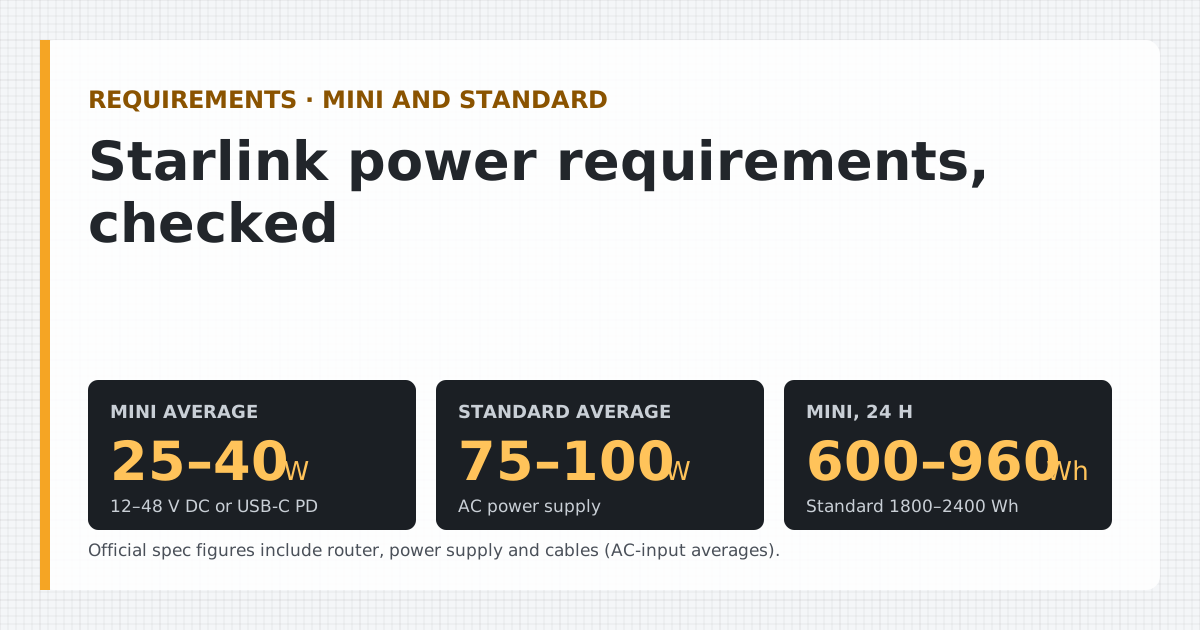
- Mini: averages 25–40 W Official spec: From a Starlink specification sheet or help article. Checked Oct 5, 2026, idles at 15 W, input rated 12 V–48 V DC at 60 W, or USB-C PD at 100 W (20 V / 5 A).
- Standard: averages 75–100 W Official spec: From a Starlink specification sheet or help article. Checked Oct 5, 2026, idles at 20 W, AC power supply as standard; DC needs Starlink's DC-DC supply (select markets) or an inverter.
- Left on 24 hours at those averages: Mini 600–960 Wh a day, Standard 1,800–2,400 Wh a day.
- A battery for the Mini needs a 100 W USB-C PD port or a 12–48 V DC output; for the Standard, a pure sine AC outlet (or the DC-DC supply) and enough Wh for your hours.
- Starlink only guarantees Mini performance with its own power supply and cable. Everything else is at your own risk, which is why the checklist matters.
Starlink’s power requirements come down to five numbers. Mini: averages 25–40 W Official spec: From a Starlink specification sheet or help article. Checked Oct 5, 2026, idles at 15 W Official spec: From a Starlink specification sheet or help article. Checked Oct 5, 2026, takes 12 V Official spec: From a Starlink specification sheet or help article. Checked Oct 5, 2026–48 V Official spec: From a Starlink specification sheet or help article. Checked Oct 5, 2026 DC rated at 60 W Official spec: From a Starlink specification sheet or help article. Checked Oct 5, 2026, or USB-C PD at 100 W Official spec: From a Starlink specification sheet or help article. Checked Oct 5, 2026 (20 V / 5 A). Standard: averages 75–100 W Official spec: From a Starlink specification sheet or help article. Checked Oct 5, 2026, idles at 20 W Official spec: From a Starlink specification sheet or help article. Checked Oct 5, 2026, runs from an AC power supply. Any battery, inverter or socket you buy has to meet the input requirement and hold enough watt-hours for your hours. The checklist below goes line by line.
The requirements, side by side
| Requirement | Starlink Mini | Starlink Standard |
|---|---|---|
| Average power | 25–40 W Official spec: From a Starlink specification sheet or help article. Checked Oct 5, 2026 | 75–100 W Official spec: From a Starlink specification sheet or help article. Checked Oct 5, 2026 |
| Idle | 15 W Official spec: From a Starlink specification sheet or help article. Checked Oct 5, 2026 | 20 W Official spec: From a Starlink specification sheet or help article. Checked Oct 5, 2026 |
| Input | 12 V–48 V DC, 60 W rating | The Standard 4 X power supply is AC: 100-240 V, 2.5 A, 50-60 Hz. |
| USB-C option | 100 W PD, 20 V / 5 A, Starlink cable | None |
| DC option | Built in (barrel jack) | Starlink DC-DC supply, select markets |
| Supplied power supply | The Mini power supply takes 100-240 V AC, 1.6 A, 50-60 Hz. | as above |
| Power over Ethernet | Not supported | — |
| Router | Built in | Gen 3 router, included in Standard figures |
Starlink notes that its watt figures include the dish, router, power supply and cables, are measured as AC-input averages, and vary with temperature, location and use. The full list, with idle, snow-melt and owner readings, is on our watts table.
1. Match the input
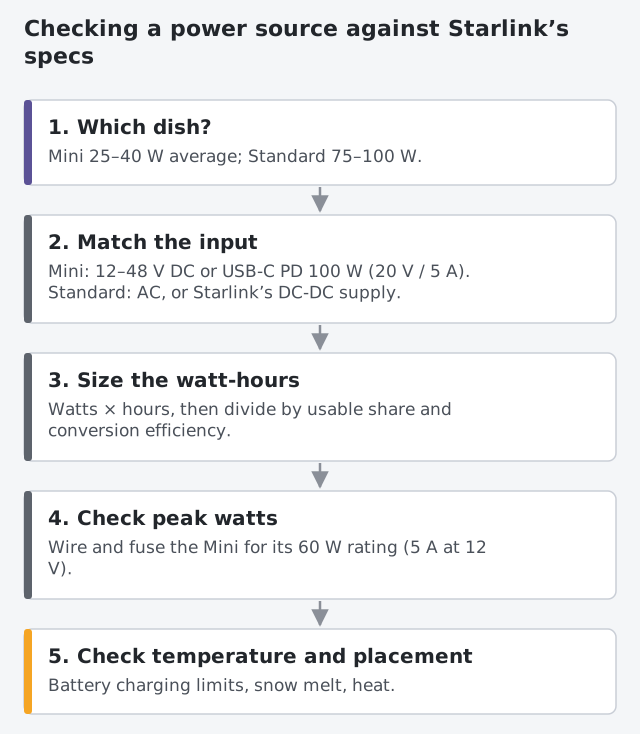
Mini. Two supported battery paths: a DC output in the 12 V–48 V range, or a USB-C PD port that delivers 100 W at 20 V / 5 A through Starlink’s USB-C to barrel cable. Starlink says Starlink says the Mini will not work with USB PD sources rated 65 W or lower. In its aviation section, Starlink also confirms In its aviation section Starlink says the Mini can be powered by a battery that meets its power requirements, and runs on 110 VAC or 12-48 VDC, 60 W. The supplied AC power supply works from any outlet or inverter.
Standard. The supplied power supply is AC. On batteries, that means an inverter or Starlink’s DC-DC supply: The Standard DC-DC Power Supply accepts 12-48 V DC at up to 30 A and outputs 56 V at 3.57 A. We’d use a pure sine inverter for any electronics’ power supply; Starlink’s documents we checked don’t specify the waveform.
Not supported: Power over Ethernet is not supported on Starlink Mini.
2. Size the watt-hours for your hours
Energy is watts × hours. Left on for 24 hours at Starlink’s averages:
| Low end | Top end | |
|---|---|---|
| Mini | 600 Wh | 960 Wh |
| Standard | 1,800 Wh | 2,400 Wh |
Real days often land lower: one van owner logged 486 Wh/day Community report: A dated measurement posted by an owner, cited. Checked Oct 5, 2026 for a Mini left on 24/7. But size for the top end if running out matters, then add the battery’s own losses: we plan with 80% of a power bank’s label being usable, 85% for a power station and 90% for LiFePO4, plus 90% conversion on DC or 87% through an inverter Planning assumption: Our stated assumption, used until bench results replace it. The runtime walkthrough shows the arithmetic, and the calculator does it for your hours.
3. Check continuous and peak watts
A battery’s output port must handle more than the average:
- Mini: wire and choose ports for the 60 W input rating. At 12 V that’s 5 A; fuse and gauge for it. Boot is the most demanding moment: one owner measured 36–39 W Community report: A dated measurement posted by an owner, cited. Checked Oct 5, 2026 for the first minutes. See startup draw.
- Standard: the power supply’s label reads: The Standard 4 X power supply is AC: 100-240 V, 2.5 A, 50-60 Hz. That nameplate (about 300 W at 120 V) is a worst-case input limit, not a draw, but an inverter should comfortably exceed the dish’s real peak. An anonymous Best Buy answer claims a Gen 3 kit draws noticeably more in its first minutes; we couldn’t verify it, so it isn’t used here.
- Router: 60 W Official spec: From a Starlink specification sheet or help article. Checked Oct 5, 2026 is the Gen 3 router’s power supply rating, not its draw. Starlink publishes no separate router figure; the Standard’s averages already include it.
4. Check the environment
Power gear has temperature limits too:
- The Mini runs from -22 °F Official spec: From a Starlink specification sheet or help article. Checked Oct 5, 2026 to 122 °F Official spec: From a Starlink specification sheet or help article. Checked Oct 5, 2026. The Mini power supply is rated IP66 Type 4.
- Starlink says Starlink says the router and power supply are also rated to operate indoors between 0 and +30°C (+32 to +86°F).
- Lithium batteries shouldn’t be charged below freezing; see charging LiFePO4 below freezing.
- Snow melt raises draw. Snow Melt has Off, Automatic (recommended) and Pre-heat modes; Pre-heat may increase power consumption and Off uses no extra power.
5. Know what Starlink guarantees
Starlink only guarantees Mini performance with the included Starlink power supply and cable. Official spec: From a Starlink specification sheet or help article. Checked Oct 5, 2026 That doesn’t mean third-party batteries don’t work; many owners run them daily. It means you carry the risk if a non-Starlink source misbehaves, so meeting the published requirement exactly is your best protection.
The battery checklist
Before you buy, the battery should have:
- For the Mini: a USB-C port labeled 20V⎓5A (100 W) on its own, or a 12–48 V DC output that can supply 60 W continuously.
- For the Standard: a pure sine AC outlet with headroom over the dish’s peak, or a DC output feeding Starlink’s DC-DC supply.
- Watt-hours for your hours at the top of the average range, after losses.
- An always-on output. Some stations switch off a port at low load; the Mini at idle can trigger it.
- Pass-through charging if it will sit on solar or a car charger while running.
- A temperature range that matches where it will live, including charging limits.
For the USB-C label in detail, see what “PD 100W” promises. For the 12 V current and wire gauge, see Starlink on 12 V.
Common mistakes
- Treating the input rating as the average. 60 W is the ceiling; size the battery at the average and the wiring at the ceiling.
- Treating the power supply’s nameplate as consumption. A supply labeled for 1.6 A or 2.5 A at 100–240 V isn’t drawing that all the time.
- Assuming any USB-C bank will do. The 20 V / 5 A profile is a hard requirement.
- Adding a router figure on top of the Standard’s. Starlink’s averages already include the router.
What to do next
Compare both dishes in Mini vs Standard power consumption, then size your battery with the calculator. Every figure on this page lives on the watts table with its source and date.
Questions people ask
What are the power requirements for Starlink?
For the Mini: 25–40 W on average, 12 V–48 V DC at up to 60 W, or USB-C PD at 100 W (20 V / 5 A). For the Standard: 75–100 W on average through its AC power supply (100–240 V).
How much power does Starlink use per day?
Left on 24 hours at Starlink's averages: about 600–960 Wh for the Mini and 1,800–2,400 Wh for the Standard. One van owner logged 486 Wh/day for a Mini left on 24/7.
What voltage does Starlink Mini need?
Starlink rates the Mini's DC input at 12 V to 48 V. Over USB-C it needs a Power Delivery source of at least 100 W at 20 V / 5 A, with Starlink's USB-C to barrel jack cable.
Does Starlink need a pure sine wave inverter?
Starlink doesn't state it in the documents we checked. Its power supplies are standard AC adapters (100–240 V); a pure sine inverter is the safe choice for any electronics' power supply, and it's what we recommend.
Can Starlink Mini be powered by PoE?
No. Starlink says Power over Ethernet is not supported on Starlink Mini.
How many watts does the Gen 3 router use?
Starlink doesn't publish a separate figure. The Gen 3 router comes with a 60 W power supply, which is a rating, not a draw; the Standard's published averages already include the router.
Sources
- Starlink Mini Specifications (PDF) · retrieved
- Standard 4 X Specifications (PDF) · retrieved
- How much power does my Starlink need? (Starlink Help Center) · retrieved
- What are the supported power sources on Starlink Mini? (Starlink Help Center) · retrieved
- Does Starlink Mini support power over ethernet? (Starlink Help Center) · retrieved
- DC-DC Power Supply Specifications, Standard Kit (PDF) · retrieved
- Mini Accessories guide (PDF) · retrieved
- Starlink Mini Install: Power, Wiring, & Mounting to our Van (FarOutRide) · retrieved
Starlink figures render from our watts table and fact file with the date we checked them. Runtime and solar math uses the planning assumptions on how we get our numbers until bench results replace them.
Independent · not affiliated with SpaceX or Starlink. We don’t sell Starlink. Links to Starlink’s plan pages here use the site owner’s own referral link (Starlink may give the owner a referral reward; your price is the same); nothing else in this article earns us anything. We haven’t used a Starlink Mini ourselves: Mini figures come from Starlink’s published specs or dated owner reports, labeled that way. General information, not electrical advice. How we make money · Report an error