Key takeaways
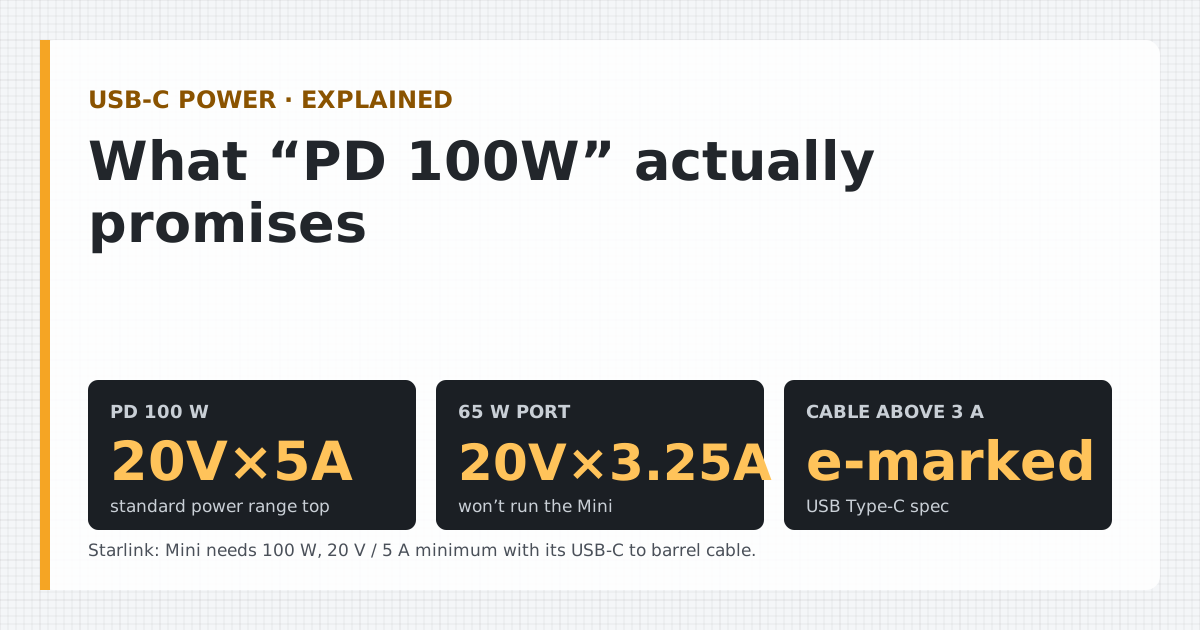
- "PD 100W" should mean the port can supply 20 V at 5 A. That's exactly what Starlink requires for the Mini: 100 W Official spec: From a Starlink specification sheet or help article. Checked Oct 5, 2026, 20 V / 5 A, with its USB-C to barrel cable.
- A 65 W port tops out at 20 V × 3.3 A. Starlink says the Mini won't work with sources rated 65 W or lower.
- Look for "20V⎓5A" next to a single port. "100W total" across several ports, or 100 W only with nothing else plugged in, are common traps.
- 5 A needs an e-marked cable: the USB Type-C spec says every cable rated above 3 A is electronically marked. For the Mini, use Starlink's own USB-C cable.
- Newer PD 3.1 chargers go to 240 W Standard: From a regulator, standards body or reference table. Checked Oct 5, 2026 at higher voltages, but the Mini's requirement is the 20 V / 5 A profile; extra wattage beyond it isn't needed.
“PD 100W” means a USB-C port can supply 100 watts through USB Power Delivery, which in the standard range is 20 volts at 5 amps. That’s exactly the profile Starlink requires to run a Mini over USB-C: 100 W Official spec: From a Starlink specification sheet or help article. Checked Oct 5, 2026 at 20 V / 5 A, with Starlink’s USB-C to barrel cable. But the number on the box often describes the whole device, not one port, and 5 A only flows through a cable built for it. Here’s how to tell whether a bank or charger will really work.
How USB Power Delivery works, briefly
A USB-C charger doesn’t just push power. The charger and the device first agree on a voltage and maximum current from a short list of profiles, then power flows. That negotiation is USB Power Delivery, “PD”.
- Standard range: USB-IF says USB-IF: before PD 3.1, USB PD topped out at 100 W, using 20 V over Type-C cables rated at 5 A. So 100 W is the top of the classic PD range, and it’s only reachable as 20 V × 5 A.
- Extended range (PD 3.1): USB-IF: USB PD 3.1 adds 28 V, 36 V and 48 V for 140, 180 and 240 W. Those higher voltages are for devices that ask for them.
The Mini’s requirement sits at the very top of the standard range. There’s no slack: a port that maxes out a little lower doesn’t run it a little worse; it doesn’t run it.
Why the Mini needs the full 100 W
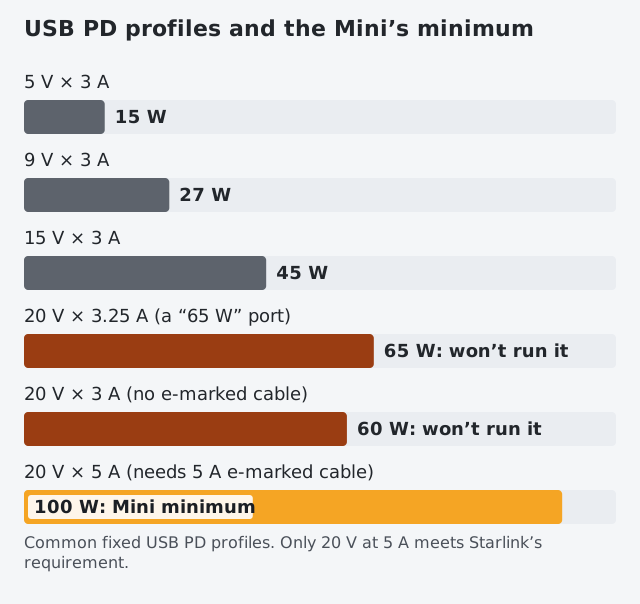
Starlink’s help center: To power the Mini over USB-C, Starlink requires a USB PD source of at least 100 W (20 V / 5 A), using Starlink's USB-C to barrel jack cable. And: Starlink says the Mini will not work with USB PD sources rated 65 W or lower.
On paper the Mini averages 25–40 W Official spec: From a Starlink specification sheet or help article. Checked Oct 5, 2026, so why demand a 100 W source? Because its input is rated at 60 W Official spec: From a Starlink specification sheet or help article. Checked Oct 5, 2026, it draws more at boot (one owner measured 36–39 W Community report: A dated measurement posted by an owner, cited. Checked Oct 5, 2026 for the first minutes), and a USB-C source that’s working at its limit droops or shuts off. The 100 W profile is the headroom: about 1.7× the input rating.
A 65 W port tops out at 20 V × 3.3 A. The Mini asks for more and the port refuses or cuts out.
Reading a power bank or charger label
The marketing number and the port rating are different things. On the label (often tiny, on the back or bottom), look for:
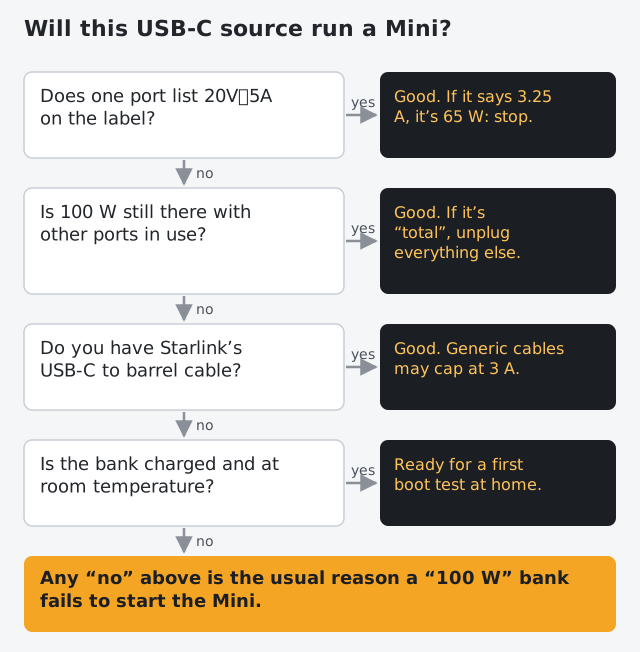
- “USB-C1: 5V⎓3A, 9V⎓3A, 15V⎓3A, 20V⎓5A” or similar, listed per port. The 20 V line must say 5 A. If it says 3.25 A, that’s 65 W.
- “Total output 100W” or “Max 100W (combined)”. This is the trap. A bank with two USB-C ports might give 100 W to one port alone but split it 65 + 30 when both are used. Plug nothing else in while it runs the Mini.
- Which port. Many banks have one 100 W port and one smaller one. The label shows which is which.
- Low-battery behavior. Some banks drop their highest profile when nearly empty. Not usually on the label; reviews or a USB-C meter will show it.
The cable is half the profile
At 5 A, the cable matters as much as the port. The USB Type-C specification says USB Type-C spec: every cable rated above 3 A is an electronically marked (e-marked) cable, so 100 W (20 V x 5 A) needs a 5 A e-marked cable. The e-marker is a chip in the plug that tells the charger the cable can carry 5 A. Without it, a correctly working charger limits itself to 3 A, which is 60 W at 20 V, and the Mini fails.
For the Mini there’s a simpler rule: use Starlink’s cable. USB-C power requires Starlink's own USB-C to Barrel Jack cable accessory (Mini USB-C Cable), sold in the Starlink Shop. The Starlink Mini USB-C Cable is 5 m (16.4 ft) long and replaces the kit's 15 m power cable. Starlink adds that it’s Starlink's USB-C cable is only for powering the Mini; it is not for charging phones and not compatible with the Gen 3 Router. And The barrel-jack end of the USB-C cable seals to IP67 at the Mini; the USB-C end should not be exposed outdoors.
When “100 W” still fails: owner reports
Real failures from owner threads, each dated and linked on our watts table and sources below:
- A TacomaWorld member's two 100 W PD power banks would not power the Mini at all (no red light). Community report: A dated measurement posted by an owner, cited. Checked Oct 5, 2026
- Another member says his 65 W PD output works only with a short cable, and suggests a '100 W' bank may not really deliver 100 W. Community report: A dated measurement posted by an owner, cited. Checked Oct 5, 2026
- A reader's Goal Zero Yeti 1000X would not start the Mini from its 60 W USB-C port or its 12 V Anderson output; only the AC adapter worked. Community report: A dated measurement posted by an owner, cited. Checked Oct 5, 2026
The second report is interesting: a 65 W output working “only with a short cable” goes against Starlink’s statement, and the owner himself suggested his “100 W” bank may not have delivered 100 W. We’d treat any sub-100 W success as luck, not a plan. Starlink only guarantees Mini performance with its own power supply and cable.
PD 3.1, 140 W and 240 W chargers
Bigger chargers are fine for the Mini as long as they include the standard 20 V / 5 A profile, which they normally do. The extra wattage is reached at 28, 36 or 48 V, which the Mini doesn’t request over USB-C. Don’t pay for 240 W for the Mini’s sake. Do make sure the cable is Starlink’s.
PD trigger boards and “USB-C to DC” adapters
A PD trigger is a small board that asks a USB-C source for a fixed voltage (say 20 V) and outputs it on plain DC wires. In principle a 20 V trigger feeding the Mini’s barrel jack sits inside the Mini’s 12 V–48 V input range. In practice, the trigger and its cable also need to handle 5 A, and Starlink only guarantees its own cable. Our battery bench protocol uses a trigger board to load-test banks at the Mini’s profile; we don’t recommend one as your daily power path.
Quick checklist
- One port, labeled 20V⎓5A (100 W).
- Nothing else plugged into the bank while it runs the Mini.
- Starlink’s USB-C to barrel cable, not a generic cable plus adapter.
- Bank charged and at room temperature for the first boot.
- USB-C end and bank kept out of rain.
What to do next
Battery size is the next question: how long a battery runs the Mini works it out by watt-hours. For banks that pass the label check, our USB-C power bank guide covers capacity, flying limits and what our bench will measure.
Questions people ask
What does USB PD 100W mean?
It means the port can negotiate USB Power Delivery up to 100 W, which in the standard (pre-PD 3.1) range is 20 V at 5 A. To actually deliver 5 A, the cable must be rated and electronically marked for 5 A.
Will a 100W power bank run a Starlink Mini?
If one port really delivers 20 V at 5 A and you use Starlink's USB-C to barrel cable, it should. Owners report some "100 W" banks failing, usually because 100 W was shared across ports or wasn't available from the port they used.
Can I use a 65W charger for Starlink Mini?
No. Starlink says the Mini will not work with USB PD sources rated 65 W or lower. A 65 W port can't supply the 20 V / 5 A profile the Mini requires.
Is a 140W or 240W USB-C charger OK for the Mini?
Yes, as long as it offers the standard 20 V / 5 A profile, which PD 3.1 chargers normally keep. The Mini simply uses what it needs; the higher-voltage profiles (28, 36, 48 V) are for devices that ask for them.
Do I need a special USB-C cable for 100W?
Yes. Above 3 A, a USB-C cable must contain an e-marker chip that tells the charger it can carry 5 A. For the Mini, Starlink requires its own USB-C to barrel jack cable, which isn't meant for phones.
What does 20V⎓5A mean on a label?
It lists one power profile the port supports: 20 volts direct current at up to 5 amps, which is 100 watts. A port label usually lists several profiles (5 V, 9 V, 15 V, 20 V); the 20 V line is the one that matters for the Mini.
Sources
- What USB power rating do I need to power my Starlink Mini? (Starlink Help Center) · retrieved
- Starlink Mini Specifications (PDF) · retrieved
- Starlink Mini - USB-C Cable (Starlink Help Center) · retrieved
- USB Charger (USB Power Delivery) - USB-IF · retrieved
- USB Type-C Cable and Connector Specification Release 2.0 (USB-IF) · retrieved
- Show us your Starlink Mini setup! page 3 (TacomaWorld) · retrieved
- Starlink Emergency Kit - Powering the Mini with a USB-C power bank (DISHYtech) incl. reader comments · retrieved
Starlink figures render from our watts table and fact file with the date we checked them. Runtime and solar math uses the planning assumptions on how we get our numbers until bench results replace them.
Independent · not affiliated with SpaceX or Starlink. We don’t sell Starlink. Links to Starlink’s plan pages here use the site owner’s own referral link (Starlink may give the owner a referral reward; your price is the same); nothing else in this article earns us anything. We haven’t used a Starlink Mini ourselves: Mini figures come from Starlink’s published specs or dated owner reports, labeled that way. General information, not electrical advice. How we make money · Report an error