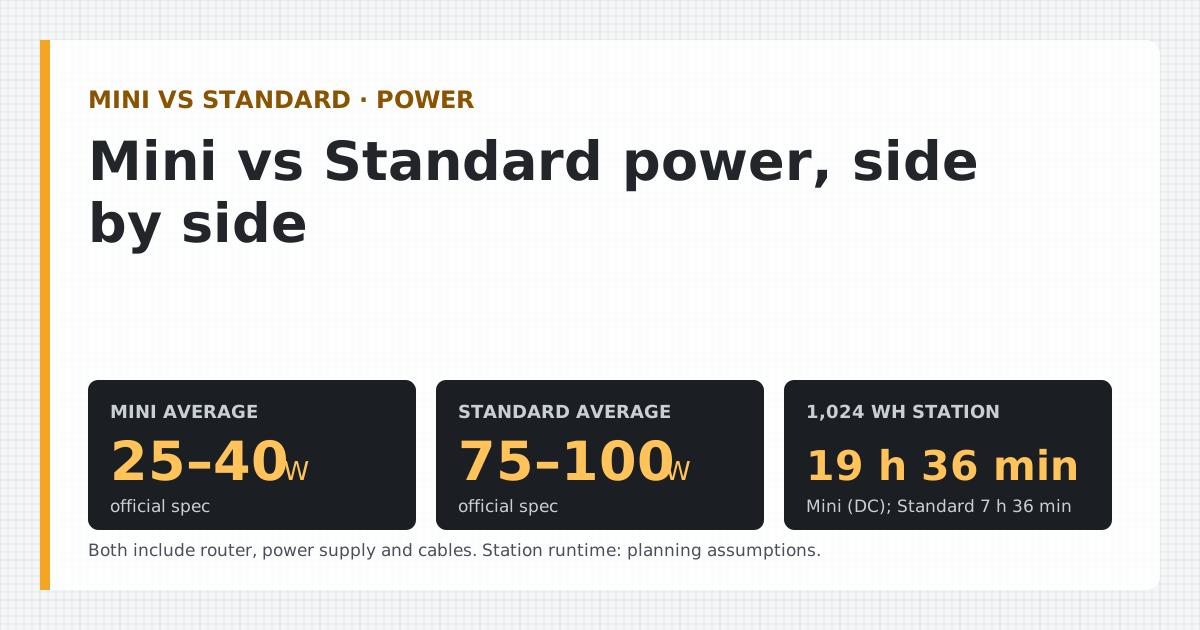
Key takeaways
- Starlink's averages: Mini 25–40 W Official spec: From a Starlink specification sheet or help article. Checked Oct 5, 2026, Standard 75–100 W Official spec: From a Starlink specification sheet or help article. Checked Oct 5, 2026, Standard Actuated 50–75 W Official spec: From a Starlink specification sheet or help article. Checked Oct 5, 2026. Idle: Mini 15 W, Standard 20 W.
- Left on 24 hours: Mini 600–960 Wh, Standard 1,800–2,400 Wh at those averages.
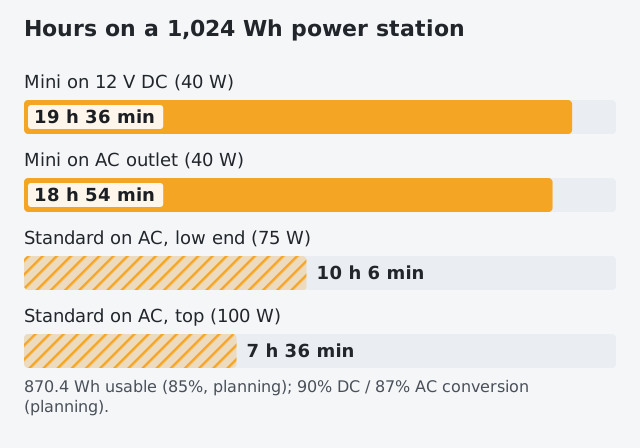
- On a 1,024 Wh power station at the top of each range: Mini about 19 h 36 min on 12 V, Standard about 7 h 36 min through the AC outlet.
- The Mini runs from 12–48 V DC or USB-C directly. The Standard needs AC (an inverter) or Starlink's DC-DC supply, which adds weight and losses.
- For a 24/7 off-grid dish in a Denver December, the panel needed is about 622 W for the Mini and 1,607 W for the Standard.
On Starlink’s own figures, the Standard averages 75–100 W Official spec: From a Starlink specification sheet or help article. Checked Oct 5, 2026 and the Mini 25–40 W Official spec: From a Starlink specification sheet or help article. Checked Oct 5, 2026, so the Standard draws about 2.5–3 times as much. Both figures include the router and power supply. On a 1,024 Wh power station that’s about 19 h 36 min for the Mini versus 7 h 36 min for the Standard, and the Mini can skip the inverter entirely. If you’ll run on batteries or solar, that gap decides the size of everything else.
The published numbers
Starlink says all of its power figures include the dish, router, power supply and cables, are measured as AC-input averages, and vary with temperature, location and use. The help center lists the Mini’s average as 20–40 W Official spec: From a Starlink specification sheet or help article. Checked Oct 5, 2026, a lower bottom end than the spec sheet; we plan with the spec sheet. Every reading with its date is on the watts table.
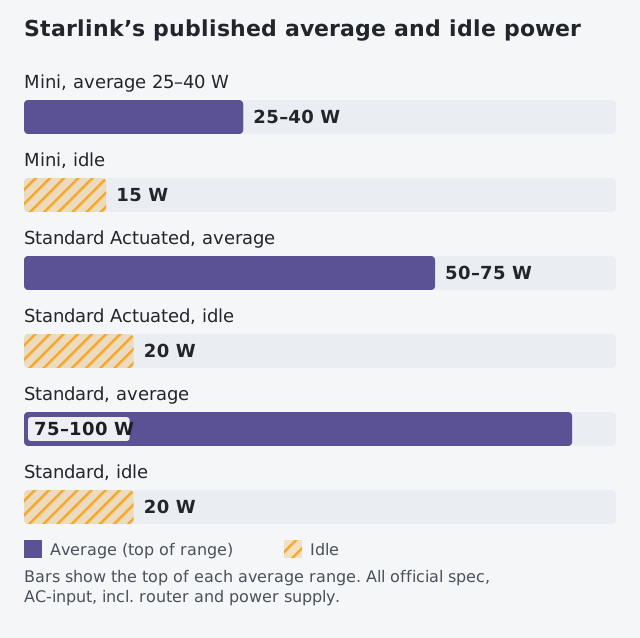 25–40 W, Standard Actuated 50–75 W, Standard 75–100 W, with idle figures." loading="lazy" decoding="async">
What owners measure
Owner logs of the Mini sit at or below the spec: one van owner logged 18–20 W Community report: A dated measurement posted by an owner, cited. Checked Oct 5, 2026 idle and 39 W Community report: A dated measurement posted by an owner, cited. Checked Oct 5, 2026 in heavy use on 12 V, 486 Wh/day across a 24/7 day. For the current Standard we found no dated, method-stated owner log we’d rely on; the readings we found (relayed Reddit figures on a Best Buy Q&A) are listed as unverified on our watts table. An older Gen 2 dish on an owner-built 12 V conversion measured 30–40 W Community report: A dated measurement posted by an owner, cited. Checked Oct 5, 2026, but that’s a modified system, not the current Standard.
A day of energy
Left on for 24 hours at Starlink’s averages:
| Low end | Top end | |
|---|---|---|
| Mini | 600 Wh | 960 Wh |
| Standard | 1,800 Wh | 2,400 Wh |
Even at the bottom of its range, the Standard uses more in a day than the Mini at the top of its range. On the grid, that’s a few dollars a month (see electricity use per month). On a battery, it’s the difference between a backpack and a hand truck.
On a power station
At the top of each dish’s average, on a 1,024 Wh station (870.4 usable Wh at our 85% planning figure Planning assumption: Our stated assumption, used until bench results replace it):
| Path | Runtime | |
|---|---|---|
| Mini | 12 V DC or USB-C PD (90% conversion) | 19 h 36 min |
| Mini | AC outlet with its own power supply (87%) | 18 h 54 min |
| Standard | AC outlet (87%) | 7 h 36 min |
| Standard, low end of range | AC outlet | 10 h 6 min |
The Mini has two advantages stacked: it draws less, and it can skip the inverter. The Standard on a station runs through the inverter unless you have Starlink’s DC-DC supply (Starlink sells a Standard DC-DC Power Supply (select markets) to run Standard 4 / 4 X from a DC source without an inverter; it uses XT60 connectors and 12 AWG wire.).
On solar
For a dish left on 24/7 at the top of its average, in a Denver December (2.3 flat-panel peak sun hours) with our 75% planning derate:
- Mini: about 622 W of panel.
- Standard: about 1,607 W of panel.
That’s a portable kit versus a roof-sized array. The three-number method shows the math for other states and months.
Why the Mini draws less
Starlink doesn’t publish a breakdown, so we can only point to what’s visible in the specs: the Mini is a smaller dish (Starlink Mini measures 298.5 x 259 x 38.5 mm (11.75 x 10.2 x 1.45 in).), it has its router built in rather than a separate unit with its own supply, and it has no motors (Starlink Mini uses software-assisted manual orienting (no motors).). The Standard is larger, melts snow faster (1.5 in/hr versus 1 in/hr), and Starlink’s comparison article sets out other differences. We won’t assign watts to each difference; nobody has published that.
When the Standard is still the right pick
Power isn’t everything. The Standard may be the better choice when:
- It’s a fixed home install on grid power. The extra power costs a few dollars a month.
- You need its other characteristics, which Starlink compares in its Mini vs Standard 4 X article and we cover on Mini vs Standard.
- Your plan or location needs it. Residential plans don’t support the Mini in most places; see the hub page.
And the Mini is the right pick whenever the power comes from a battery, a car or a panel.
What to do next
Our Mini vs Standard guide adds weight, portability and battery sizes for each. To see your own hours on each dish, switch the terminal in the calculator.
Questions people ask
Does Starlink Mini use less power than Standard?
Yes. Starlink lists the Mini at 25–40 W on average and the Standard at 75–100 W, both including the router and power supply. The Standard is about 2.5–3× the Mini.
How many watts does a Standard Starlink use?
Starlink lists Standard 4 / 4 X at 75–100 W average and 20 W idle. The Standard Actuated averages 50–75 W. Snow melt can push draw higher.
Which Starlink is best for battery power?
The Mini, by a wide margin: lower draw, a DC input that takes 12–48 V, and a USB-C option. Pick the Standard on batteries only if you need what it offers beyond power and can carry the larger battery.
Is the Mini’s built-in router included in its power figure?
Yes. Starlink says its power figures include the router, power supply and cables. The Mini's router is built in; the Standard's figures include its Gen 3 router.
Which uses more power in snow, Mini or Standard?
Starlink doesn't publish either dish's snow-melt draw. The Standard melts snow faster (1.5 in/hr versus the Mini's 1 in/hr). SlashGear cites a Reddit screenshot suggesting heating adds a noticeable amount on a Standard; we couldn't verify the figure, so we don't use it.
Can I run a Standard Starlink on a power bank?
Not a USB-C power bank: the Standard has no USB-C power input. It needs AC from a power station or inverter, or Starlink's DC-DC supply from a 12–48 V battery.
Sources
- Starlink Mini Specifications (PDF) · retrieved
- Standard 4 X Specifications (PDF) · retrieved
- Starlink Product Specifications, Standard Actuated (PDF) · retrieved
- How much power does my Starlink need? (Starlink Help Center) · retrieved
- What are the differences between Starlink Mini and Standard 4 X? (Starlink Help Center) · retrieved
- DC-DC Power Supply Specifications, Standard Kit (PDF) · retrieved
- What Does 'Heating' Mean On Starlink? (SlashGear) · retrieved
- NASA POWER Climatology API (ALLSKY_SFC_SW_DWN, 2001–2020) · retrieved
Starlink figures render from our watts table and fact file with the date we checked them. Runtime and solar math uses the planning assumptions on how we get our numbers until bench results replace them.
Independent · not affiliated with SpaceX or Starlink. We don’t sell Starlink. Links to Starlink’s plan pages here use the site owner’s own referral link (Starlink may give the owner a referral reward; your price is the same); nothing else in this article earns us anything. We haven’t used a Starlink Mini ourselves: Mini figures come from Starlink’s published specs or dated owner reports, labeled that way. General information, not electrical advice. How we make money · Report an error