Key takeaways
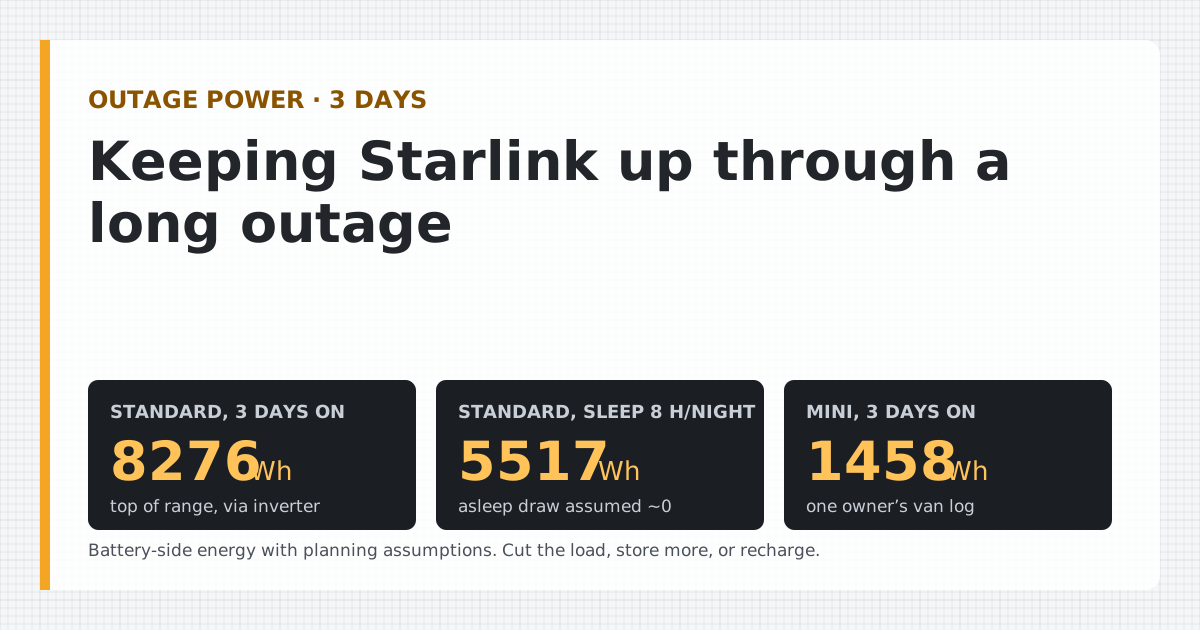
- A Standard dish left on 24 hours at the top of its average (100 W) takes about 2,759 Wh a day from a battery through an inverter; three days, about 8,276 Wh.
- Off 8 hours a night, three days drops to about 5,517 Wh. A Mini left on 24/7 (one owner's 486 Wh/day) needs about 1,458 Wh for three days.
- The biggest battery class we model (a 48 V 100 Ah LiFePO4, 4,608 usable Wh Planning assumption: Our stated assumption, used until bench results replace it) runs a Standard about 40 h 6 min. Beyond that you need a recharge.
- A September outage in Orlando needs about 747 W of panel to keep a Standard on 24/7, or about 91 W for a Mini off overnight.
- Generators fill the gap fastest; run them outdoors and never back-feed. Solar is quiet and fuel-free but sized by the season.
To keep a Standard dish online through a three-day outage you need about 8,276 Wh from a battery if it’s left on around the clock at the top of its average range (100 W Official spec: From a Starlink specification sheet or help article. Checked Oct 5, 2026, through an inverter). That’s more than any portable battery class we model. So a multi-day plan has three levers: cut the load (sleep hours, or run a Mini instead), store more (a big station or rack battery), and recharge (solar or a generator). Most households need at least two of them.
Step 1: the daily energy
Starting from Starlink’s published averages, which include the router and power supply, and our planning efficiency of 87% through a power station’s inverter (90% on 12 V for the Mini) Planning assumption: Our stated assumption, used until bench results replace it:
| Setup | Per day from the battery | 3 days |
|---|---|---|
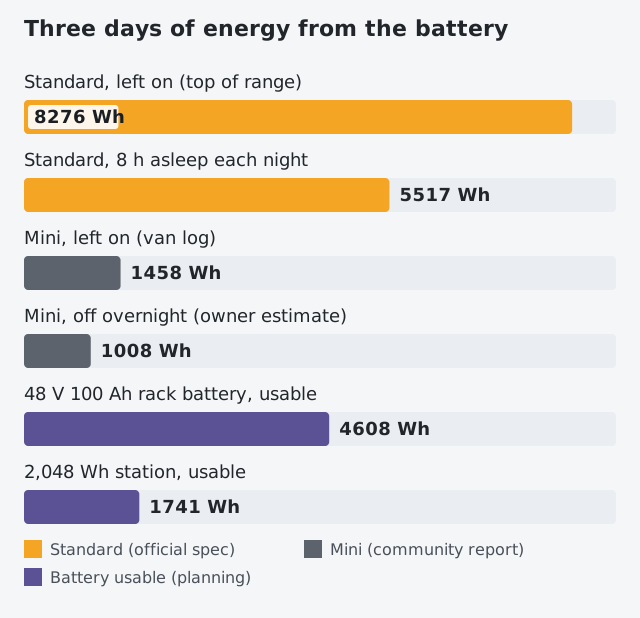
| Standard, 24 h, top of range (100 W) | 2,759 Wh | 8,276 Wh |
| Standard, 24 h, low end (75 W) | 2,069 Wh | 6,207 Wh |
| Standard, 16 h on, 8 h asleep overnight | 1,839 Wh | 5,517 Wh |
| Mini, 24 h, top of range (40 W) | 1,067 Wh | — |
| Mini, 24 h, one owner’s van log | 486 Wh/day Community report: A dated measurement posted by an owner, cited. Checked Oct 5, 2026 | 1,458 Wh |
| Mini, off overnight (owner’s estimate) | 336 Wh | 1,008 Wh |
The asleep hours assume near-zero draw, which Starlink doesn’t publish; measure your own with a plug-in meter before you rely on it. Starlink’s description of the sleep schedule: The Starlink app's Sleep Schedule (Settings > Starlink > Sleep Schedule) can be used to save power; while asleep Starlink gives no internet, does not melt snow, and can't be managed remotely. Official spec: From a Starlink specification sheet or help article. Checked Oct 5, 2026
Step 2: what batteries cover
| Battery class (label) | Usable Wh Planning assumption: Our stated assumption, used until bench results replace it | Standard, top of range | Mini, top of range (12 V) |
|---|---|---|---|
| 512 Wh station | 435.2 | 3 h 48 min | 9 h 48 min |
| 1,024 Wh station | 870.4 | 7 h 36 min | 19 h 36 min |
| 2,048 Wh station | 1,741 | 15 h 6 min | — |
| 48 V 100 Ah LiFePO4 rack battery (5,120 Wh) | 4,608 | 40 h 6 min | — |
Read it this way:
- One night: a 1,024 Wh station keeps a Standard up overnight; a 512 Wh station does it for a Mini with lots to spare.
- One to two days: a 2,048 Wh station for a Standard with sleep hours; a 1,024 Wh station for a Mini left on.
- Three days: only the rack battery gets a Standard close without recharge, and only with sleep hours. A Mini off overnight (1,008 Wh) is just over a 1,024 Wh class station’s 870.4 usable Wh, so a 2,048 Wh class covers it, or a 1,024 Wh station plus a little solar.
For a Standard on a 12–48 V battery, Starlink’s DC-DC supply skips the inverter: The Standard DC-DC Power Supply accepts 12-48 V DC at up to 30 A and outputs 56 V at 3.57 A. It’s sold in select markets.
Step 3: recharge with solar
Solar works in an outage if it’s sized for the season. Outages cluster in storm seasons, so we’ll use September (hurricane season on the Gulf and Atlantic coasts) and NASA’s 20-year flat-panel averages, with our 75% planning derate:
| Load | Orlando, FL | Houston, TX | Charlotte, NC |
|---|---|---|---|
| Standard, 24 h | 747 W | 732 W | 781 W |
| Standard, 16 h | 498 W | — | — |
| Mini, 24 h, top of range | 289 W | — | — |
| Mini, off overnight (owner log) | 91 W | — | — |
Sun hours used: 4.9 (Orlando), 5 (Houston), 4.7 (Charlotte). These are monthly averages. The days right after a hurricane may be clear; the days during one won’t produce much. In a winter ice storm, sun hours are a fraction of September’s; see summer vs winter and charging LiFePO4 below freezing.
The pattern is clear: keeping a Standard on 24/7 from solar takes a substantial array, while a Mini off overnight needs about one portable panel.
Step 4: a generator, safely
A generator refills a battery faster than any portable panel. Starlink is a small load on it, so the generator can run a few hours a day to recharge a power station that carries the dish the rest of the time. That’s quieter, uses less fuel than running all day, and means no generator running unattended overnight.
The safety rules are non-negotiable: outdoors only, more than 20 feet from doors, windows and vents, never in a garage, CO alarms near sleeping areas, and never back-feed the house through an outlet. Our generator safety guide covers them with the CDC and Ready.gov sources.
Three ready-made plans
Plan A: Standard, comfort-first. 2,048 Wh station or larger, sleep schedule overnight, generator 2–3 hours a day to recharge (or a roof or ground array sized for the season). Covers a long outage with the dish on all day.
Plan B: Standard, battery and solar only. Rack battery or a large station, 16 hours on, plus the panel watts in the table for your season. Quiet and fuel-free; vulnerable to a cloudy week.
Plan C: Mini as the outage dish. A Mini on a 1,024 Wh station’s 12 V port, off overnight, with one portable panel. By far the smallest kit. The Mini needs its own service plan, so weigh that cost before buying one just for outages.
Before the next outage
- Test it. Run the dish on your backup for an evening while the grid is up. Note the battery percentage before and after.
- Charge everything when storms are forecast; Ready.gov’s outage guidance includes planning for batteries and alternative power sources.
- Know your router’s behavior. Some setups drop when switching to a UPS. Our UPS guide explains why and what to look for.
- Write down the sleep-schedule steps and test them; you won’t want to learn the app in the dark.
What we don’t know
Starlink doesn’t publish the dish’s draw while asleep, during snow melt, or at startup for the Standard. Our battery and solar numbers use stated planning assumptions until our bench replaces them. If you measure your own dish on a plug-in meter through a full day, you’ll have a better daily figure than any table here.
What to do next
Put your dish, hours and battery into the calculator (choose Standard and AC, or Mini and 12 V). For the battery that sits between the wall and the dish every day, start with the UPS guide, and for the general options, our outage power page.
Questions people ask
How long can Starlink run on a battery during a power outage?
At the top of its average range, a Standard dish runs about 7 h 36 min on a 1,024 Wh power station and 15 h 6 min on a 2,048 Wh one, through the AC outlet. A Mini on 12 V runs about 19 h 36 min on the 1,024 Wh station.
How big a battery do I need to run Starlink for 3 days?
For a Standard left on: about 8,276 Wh from the battery at the top of its range, which is more than any battery class we model. Cut it with sleep hours (5,517 Wh) or switch to a Mini (about 1,458 Wh at one owner's logged rate), or add a recharge.
Does Starlink work during a power outage?
Yes, as long as the dish and router have power and the sky is clear enough. The satellites don't depend on your local grid. Starlink needs power the whole time it runs.
Can solar keep Starlink running in an outage?
Yes, if the panel is sized for the season and you have a battery for nights. A Standard left on in a Orlando September needs about 747 W of panel by our method; a Mini off overnight about 91 W.
Should I use a Starlink Mini as an outage backup?
Power-wise it's far easier: it draws well under half of a Standard and runs from 12–48 V DC or USB-C. It needs its own service plan, so check the cost and what your plan allows before you buy one for this.
Can I keep my router and dish on a UPS during an outage?
Yes, but a typical small UPS is built for minutes, not days. It's a good bridge to a generator or power station; see our UPS guide for runtime and why some setups still drop.
Sources
- How much power does my Starlink need? (Starlink Help Center) · retrieved
- Standard 4 X Specifications (PDF) · retrieved
- How do I set up sleep schedule? (Starlink Help Center) · retrieved
- Starlink Mini Install: Power, Wiring, & Mounting to our Van (FarOutRide) · retrieved
- NASA POWER Climatology API (ALLSKY_SFC_SW_DWN, 2001–2020) · retrieved
- Power Outages (Ready.gov) · retrieved
- DC-DC Power Supply Specifications, Standard Kit (PDF) · retrieved
Starlink figures render from our watts table and fact file with the date we checked them. Runtime and solar math uses the planning assumptions on how we get our numbers until bench results replace them.
Independent · not affiliated with SpaceX or Starlink. We don’t sell Starlink. Links to Starlink’s plan pages here use the site owner’s own referral link (Starlink may give the owner a referral reward; your price is the same); nothing else in this article earns us anything. We haven’t used a Starlink Mini ourselves: Mini figures come from Starlink’s published specs or dated owner reports, labeled that way. General information, not electrical advice. How we make money · Report an error