Key takeaways
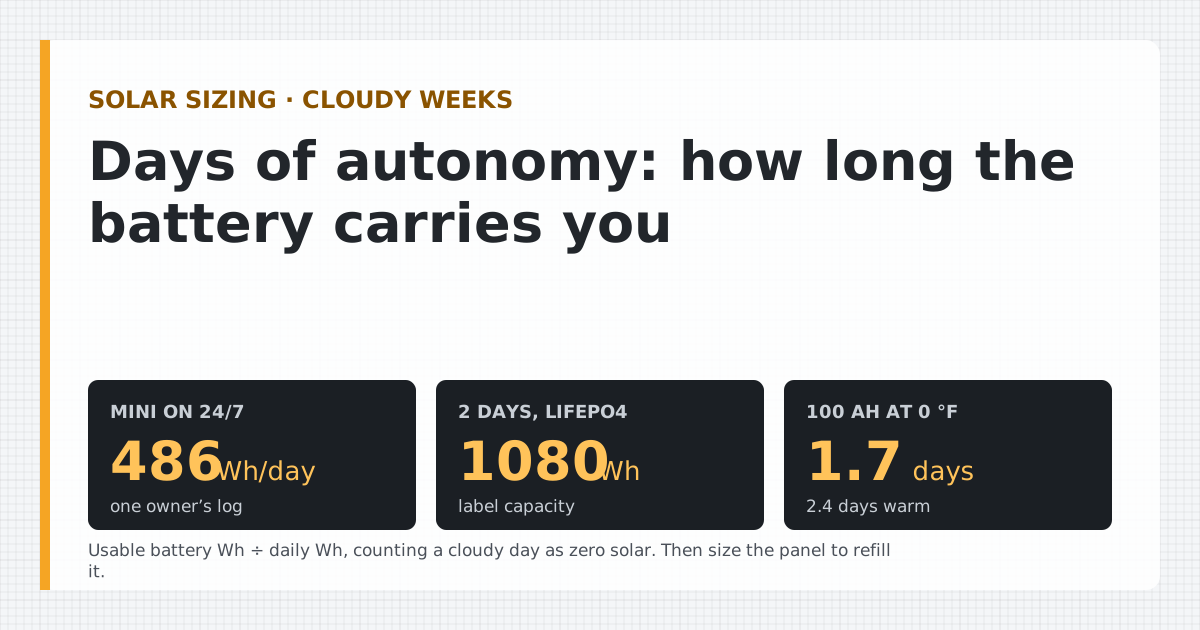
- Days of autonomy = usable battery Wh ÷ daily Wh from the battery. Count a cloudy day as zero solar; it's the safe case.
- At one owner's measured 486 Wh a day (Mini on 24/7), a 12 V 100 Ah LiFePO4 covers about 2.4 days and a 1,024 Wh station about 1.8 days, using our usable-share planning figures.
- Two days of autonomy at that use takes about 1,080 Wh of LiFePO4 label capacity, or 747 Wh if the Mini is off overnight. At the top of Starlink's average range it's about 2,370 Wh.
- Cold cuts it: Battle Born's 0 °F figure drops that 100 Ah battery from 2.4 to about 1.7 days.
- Autonomy only helps if you can refill. In a Denver December, putting two empty days back over three sunny days takes about 189 W of panel on top of the 283 W the daily load needs.
Days of autonomy is usable battery energy divided by what the dish takes from the battery in a day. For a Starlink Mini left on 24/7, one van owner logged about 486 Wh/day Community report: A dated measurement posted by an owner, cited. Checked Oct 5, 2026. At that rate a 12 V 100 Ah LiFePO4 battery carries the Mini about 2.4 days with no sun, and a 1,024 Wh power station about 1.8 days. Two full days of autonomy takes about 1,080 Wh of LiFePO4 label capacity. Then plan the part most people skip: enough panel to refill the battery once the clouds clear.
Why solar sizing alone leaves you short
Panel sizing works from average sun: our sizing by state page uses 20-year monthly averages from NASA POWER. An average month includes its cloudy days, but it spreads them out. Real weather bunches them up. Three grey days in a row in December can happen in a month whose average looks fine on paper.
That’s the job of the battery beyond the overnight bank. Off-grid planners call it days of autonomy: how many days the battery alone can carry the load. Our panel-size guide mentions it in one line; this post does the math.
The formula
- Daily Wh from the battery. Watts × hours on, divided by conversion efficiency. We use 90% for USB-C or 12 V DC Planning assumption: Our stated assumption, used until bench results replace it. The van owner’s 486 Wh was read at the battery, so it already includes losses.
- Usable Wh of the battery. Label Wh × usable share. Our planning shares are 80% for power banks, 85% for power stations and 90% for LiFePO4 Planning assumption: Our stated assumption, used until bench results replace it. These stand in until our bench has delivered-Wh results.
- Days = usable Wh ÷ daily Wh.
Count a cloudy day as zero solar. A heavy overcast day does make some power, but how much varies too much to plan with, and we don’t have a per-day figure in our data. Treat whatever the panel makes as margin.
Days of autonomy by battery size
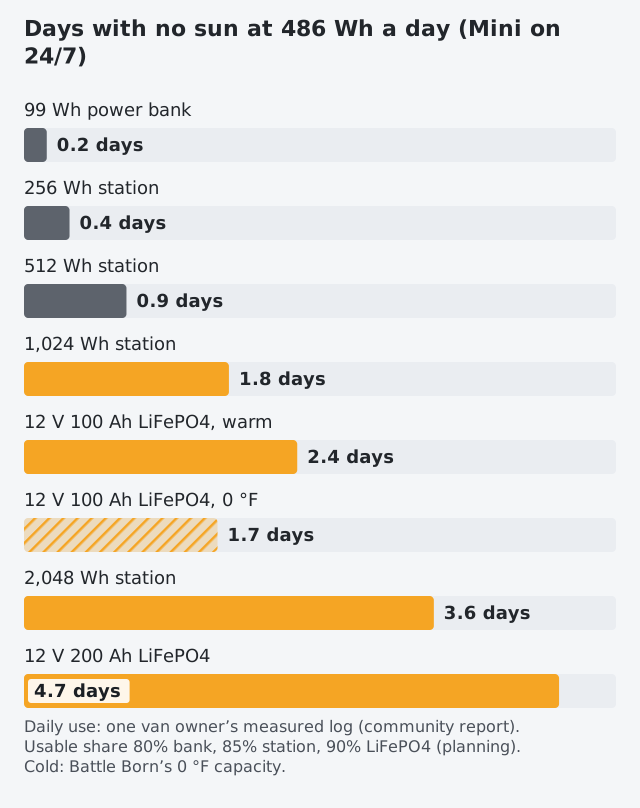
At the van owner’s 486 Wh a day Community report: A dated measurement posted by an owner, cited:
| Battery (label) | Usable Wh (planning) | Days, on 24/7 |
|---|---|---|
| 99 Wh power bank | 79.2 | 0.2 (a few hours) |
| 256 Wh station | 217.6 | 0.4 |
| 512 Wh station | 435.2 | 0.9 |
| 1,024 Wh station | 870.4 | 1.8 |
| 12 V 100 Ah LiFePO4 (1,280 Wh) | 1,152 | 2.4 |
| 2,048 Wh station | 1,741 | 3.6 |
| 12 V 200 Ah LiFePO4 (2,560 Wh) | 2,304 | 4.7 |
A power bank isn’t an autonomy battery at all; it’s a few hours of use. The two smaller stations cover less than a full day of 24/7 use, so they can bridge one bad afternoon but not a storm.
Your daily number changes everything
The van owner’s day is one real log, not a promise. Two other cases:
- Off overnight. The same owner estimated switching off at night saves about 150 Wh a day, bringing it to 336 Wh. The 100 Ah LiFePO4 then covers about 3.4 days.
- Top of Starlink’s range, 24/7. Starlink lists the Mini’s average at 25–40 W Official spec: From a Starlink specification sheet or help article. Checked Oct 5, 2026. Run it at 40 W around the clock and it takes about 1,067 Wh a day from the battery. The 100 Ah battery covers about 1.1 days, and the 200 Ah bank about 2.2.
That’s a 3× spread on the same battery, from usage alone. Put your own hours into the calculator: it reports days of autonomy for whatever battery and duty you pick.
How much battery for one, two or three days
Turned around: the label capacity you need for N days at the van owner’s 486 Wh a day.
| Days of autonomy | Power station (label Wh) | LiFePO4 (label Wh) |
|---|---|---|
| 1 day | 572 | 540 |
| 2 days | 1,144 | 1,080 |
| 3 days | 1,715 | 1,620 |
Two days of LiFePO4 becomes about 747 Wh if the Mini sleeps overnight, and about 2,370 Wh if you plan at the top of Starlink’s average range around the clock. Pick the row that matches how you actually use it, not the most hopeful one.
How many days should you pick? That depends on your local weather and what an outage costs you, and we can’t answer it from averages. A few rules of thumb hold up:
- One day covers a single bad day and the usual “battery wasn’t full at dusk” problem.
- Two to three days covers most storm fronts. Past that, battery gets expensive fast compared with a backup charge source.
- Remote work or medical needs push the number up, or push you toward a generator or grid charging as a backstop instead of more battery.
Cold weather shrinks the answer
LiFePO4 holds less energy when it’s cold. Battle Born says its 100 Ah battery delivers about 80 Ah Standard: From a regulator, standards body or reference table. Checked Oct 5, 2026 at 32 °F and about 70 Ah Standard: From a regulator, standards body or reference table. Checked Oct 5, 2026 at 0 °F, recoverable once it warms up. For the 100 Ah battery at the van owner’s daily use:
| Battery temperature | Days of autonomy |
|---|---|
| Room temperature | 2.4 |
| 32 °F | 1.9 |
| 0 °F | 1.7 |
To keep two full days at 0 °F you’d need about 1,543 Wh of label capacity rather than 1,080. The cheaper fix is to keep the battery inside the heated space.
Charging is the second cold problem. REDARC says charging LiFePO4 below 0 °C Standard: From a regulator, standards body or reference table. Checked Oct 5, 2026 (32 °F) must be avoided because of lithium plating. A battery that sat at 20 °F through a storm may not accept the first sunny morning’s charge until it warms up. Our LiFePO4 below freezing guide covers self-heating batteries and low-temperature cutoffs.
Autonomy only works if you can refill
This is where days of autonomy goes wrong in practice. After two cloudy days the battery is empty, and the panel has to run today’s load and put back 972 Wh. A panel sized only for the daily load never catches up; the next cloudy spell starts from half-empty.
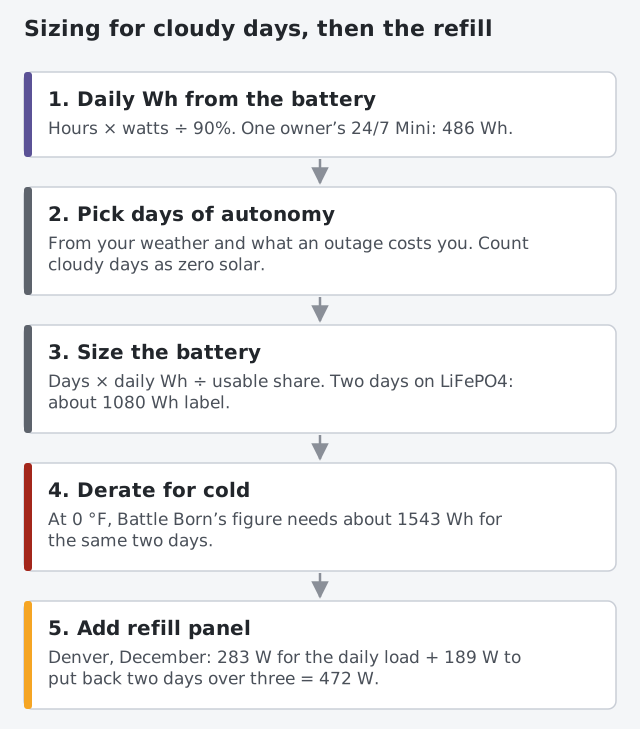
Worked example, using our usual method (panel W = Wh ÷ (peak sun hours × 75%)) Planning assumption: Our stated assumption, used until bench results replace it and the van owner’s day. We spread the 972 Wh refill over the three sunny days after the storm:
| Place and month | Peak sun hours (flat) | Panel for the daily load | Extra panel to refill 2 days over 3 | Total |
|---|---|---|---|---|
| Denver, December | 2.3 | 283 W | 189 W | 472 W |
| Seattle, December | 0.9 | 763 W | 509 W | 1,272 W |
| Denver, July | 7 | — | 62 W | — |
In a Denver December, refilling takes about two-thirds more panel than the daily load alone. In Seattle in December the total is above what most people can fit or carry, which is the honest answer: there, a bigger battery won’t save you without a generator, grid charging or fewer hours on. In July the refill barely registers.
Also check your battery’s or power station’s solar input limit. A station that accepts only a few hundred watts of solar can’t take a refill array, no matter how many panels you buy.
Common mistakes
- Counting label Wh as usable. The usable share is lower; see label vs usable.
- Assuming you start full. In winter the battery is often not full at dusk. Size from where it really starts.
- Doubling the battery but not the panel. You gain a day and lose it again on refill.
- Ignoring snow melt. Snowy hours raise the daily load; our snow post works through it.
- Forgetting the cold. Cold capacity and the charging cutoff both shrink the real number.
What we don’t know
- How much a cloudy day really produces at your site. We count it as zero; your panel will often do better.
- Delivered Wh for specific batteries. Our usable shares are planning figures until bench results replace them.
- Mini draw in your conditions. The 486 Wh day is one owner’s log. Starlink’s own range (25–40 W Official spec: From a Starlink specification sheet or help article. Checked Oct 5, 2026) spans a wide band.
What to do next
- Get your daily Wh: from your own battery monitor if you have one, otherwise the calculator.
- Pick a number of days from your weather and what an outage costs you.
- Size the battery from the tables above, then apply the cold derate if it lives outside.
- Check refill: look up your worst month on sizing by state and add the refill panel. If that number is impractical, plan a generator or grid backstop; our winter off-grid guide covers the options.
Questions people ask
What does days of autonomy mean for Starlink?
It's how many days your battery alone can keep the dish running with no help from solar or the grid. Divide the battery's usable watt-hours by what the dish takes from the battery in a day.
How many days of autonomy do I need?
There's no single answer: it depends on how long bad weather lasts where you are and what losing internet would cost you. One to three days, plus a backup charge source (generator or grid) for longer runs, is a sensible starting range for most Mini setups. More than that usually costs less as panel or a generator than as battery.
How many days will a 100Ah lithium battery run a Starlink Mini?
At one van owner's measured 486 Wh a day with the Mini on 24/7, a 12 V 100 Ah LiFePO4 covers about 2.4 days from full, using our 90% usable-share planning figure. At the top of Starlink's average range (around the clock) it's about 1.1 days, and less in deep cold.
Does a cloudy day produce zero solar?
Usually not zero, but it can be a small fraction of a clear day and it varies a lot. We count a cloudy day as zero for sizing because we don't have a reliable per-day figure to plan with; whatever the panel makes is margin.
Is it better to add battery or solar for cloudy weeks?
Panel first, if it fits: more panel shortens every cloudy spell and refills the battery faster afterwards. A bigger battery without more panel just delays the empty day and takes longer to refill. Past two or three days, a generator or grid charge is usually the cheaper backstop.
Does a sleep schedule increase days of autonomy?
Yes, because it lowers daily use. The same van owner estimated that switching off overnight saves about 150 Wh a day. Starlink says the sleep schedule gives no internet and no snow melt while asleep, so time it for hours you don't need either.
Sources
- Starlink Mini Install: Power, Wiring, & Mounting to our Van (FarOutRide) · retrieved
- Starlink Mini Specifications (PDF) · retrieved
- How much power does my Starlink need? (Starlink Help Center) · retrieved
- How do I set up sleep schedule? (Starlink Help Center) · retrieved
- How to Winterize and Store LiFePO4 Batteries (Battle Born FAQ) · retrieved
- Why you should not charge a lithium battery below 0C or 32F (REDARC support) · retrieved
- NASA POWER Climatology API (ALLSKY_SFC_SW_DWN, 2001–2020) · retrieved
Starlink figures render from our watts table and fact file with the date we checked them. Runtime and solar math uses the planning assumptions on how we get our numbers until bench results replace them.
Independent · not affiliated with SpaceX or Starlink. We don’t sell Starlink. Links to Starlink’s plan pages here use the site owner’s own referral link (Starlink may give the owner a referral reward; your price is the same); nothing else in this article earns us anything. We haven’t used a Starlink Mini ourselves: Mini figures come from Starlink’s published specs or dated owner reports, labeled that way. General information, not electrical advice. How we make money · Report an error