Key takeaways
- Yes, Starlink can keep working when the grid goes down, as long as your dish and router have power. Neither the Mini nor the Standard has a built-in battery.
- The satellites don't run on your local grid. Starlink's ground stations do need power; press reporting from the April 2025 Spain and Portugal blackout says they have generators, solar and batteries. Starlink hasn't published its backup specs that we could find.
- In that blackout, users who powered their own dishes stayed online. After Hurricane Helene in 2024, SpaceX said about 500 Starlink kits were deployed or on their way through private individuals and organizations, while communities were cut off from phone and internet.
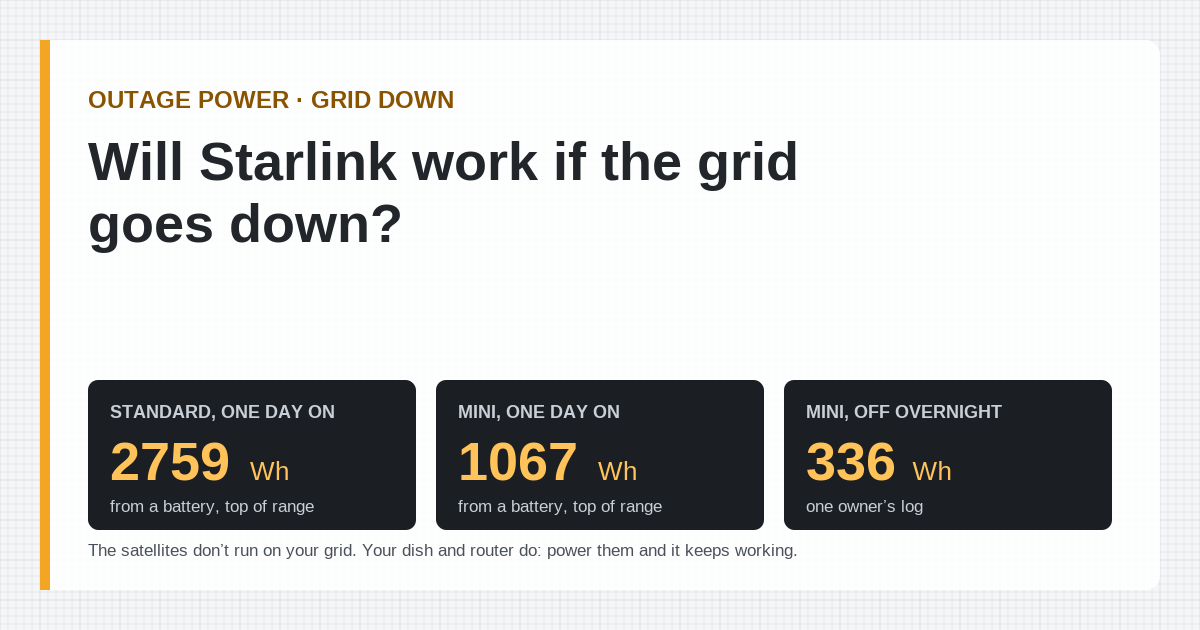
- Plan your own power: a Standard left on takes about 2,759 Wh a day from a battery; a Mini about 1,067 Wh at the top of its range, or about 336 Wh switched off overnight (one owner's log).
- Power the router and anything between it and your devices too, and keep phones and laptops charged, or the connection stops at your end.
Yes, Starlink can keep working when the grid goes down, as long as you keep your dish and router powered. The satellites don’t run on your local grid, so a blackout at your house, or across your state, doesn’t switch them off. What switches off is your end: neither the Mini nor the Standard has a built-in battery. Starlink lists the Mini at 20–40 W Official spec: From a Starlink specification sheet or help article. Checked Nov 16, 2026 and the Standard at 75–100 W Official spec: From a Starlink specification sheet or help article. Checked Nov 16, 2026 on average, router included, and that power has to come from somewhere.
So “will Starlink work if the grid goes down” is really three questions: is your equipment powered, is Starlink’s network powered, and is the sky clear.
1. Your equipment: the part you control
Everything between the dish and your screen needs power:
- The dish and its router. On a Mini they’re one unit; a Standard has a separate router. Starlink’s averages include both.
- Anything else in the chain. A mesh node, a network switch or a separate router you added goes dark in a blackout unless it’s on backup too.
- Your devices. A laptop on battery and a charged phone are part of the plan. Wi-Fi calling only works while the phone has charge.
How much battery that takes, per day, from Starlink’s averages with our planning losses (87% through an inverter, 90% on 12 V Planning assumption: Our stated assumption, used until bench results replace it):
| Setup | Per day from a battery | 3 days |
|---|---|---|
| Standard, left on, top of range | 2,759 Wh | 8,276 Wh |
| Standard, 8 hours a night asleep | 1,839 Wh | 5,517 Wh |
| Mini, left on, top of range | 1,067 Wh | — |
| Mini, left on, one owner’s van log | 486 Wh/day | 1,458 Wh |
| Mini, off overnight, same owner’s estimate | 336 Wh | 1,008 Wh |
A 1,024 Wh power station runs a Standard about 7 h 36 min and a Mini about 19 h 36 min at the top of each range. Our multi-day outage plan turns these into three ready-made setups.
2. Starlink’s network: the part you don’t control
Your dish talks to satellites, and the satellites pass your traffic to ground stations (gateways) that connect to the internet. The satellites don’t care about any grid. The ground stations do need electricity.
What’s public about how they handle blackouts:
- Press reporting, April 2025. When Spain and Portugal lost power on April 28, 2025, Xataka On reported the next day that Starlink users who powered their own dishes stayed online for the whole blackout, one saying speeds were “even better than usual”. The same article says the ground stations “come equipped with generators, solar panels and batteries” and “proved resilient during the blackout”. That is the outlet’s reporting, not a Starlink statement.
- Starlink itself hasn’t published how long its US ground stations can run on backup power, as far as we could find on November 16, 2026.
So the honest answer for a very wide, very long grid failure is: your dish will work as long as you power it and the network is up, and the network has held up in the blackouts on record. Nobody outside SpaceX can promise how it behaves in a scenario that hasn’t happened.
3. What real blackouts and disasters showed
- Spain and Portugal, April 2025: the case above. Users with power stations or home solar and batteries kept Starlink running; the article’s examples ran dishes from a portable power station topped up by a 100 W panel, and from home solar with Tesla batteries.
- Hurricane Helene, 2024: with communities in western North Carolina cut off from phone and internet, SpaceX said about 500 Starlink kits were deployed or on their way through private individuals and organizations (NBC News, October 2, 2024). Each of those still needed its own power source.
Neither event tells you about congestion. If many neighbors bring dishes online at once, speeds may change; we have no data on that.
Weather still matters
A grid-down event often comes with a storm. Starlink says moderate to heavy rain, snow and hail can cause short dropouts, and service comes back when the weather clears. Starlink also says not to add a protective cover to the dish. Snow melt raises the dish’s power draw; our snow guide has the extra watt-hours.
The smallest setup that works
- Mini-based kit: a Mini on a 1,024 Wh class station’s 12 V port, switched off overnight, plus a portable panel. In a Orlando September, about 91 W of panel keeps up with that load by our method; a Denver December needs far more (see summer vs winter).
- Standard-based kit: a 2,048 Wh station or larger, a sleep schedule overnight, and a generator a few hours a day. Run any generator outdoors and never back-feed the house; our generator safety guide covers distances and cords.
If you’re choosing a dish with grid-down use in mind, our Mini vs Standard for power outages compares them on the numbers.
What we don’t know
- How long Starlink’s US ground stations run on backup power, and whether they’d stay up in a grid failure lasting weeks.
- How the network performs when many users in one area switch to Starlink at once.
- Your own dish’s draw while asleep; measure it before you rely on the sleep-hours figures.
What to do next
Put your dish, hours and battery into the calculator, then read the outage power options. Not ordered Starlink yet? Starlink shows the kits, plans and availability for your address on starlink.com; the box below links there.
Questions people ask
If the grid goes down, will Starlink still work?
Yes, if you power it. The dish and router need electricity the whole time, from a battery, power station, generator or solar. The satellites don't depend on your local grid, so a regional blackout isn't a Starlink outage.
Does Starlink need electricity to work?
Yes. Starlink lists the Mini at 20–40 W and the Standard at 75–100 W on average, router included. Neither has a built-in battery today.
Did Starlink work during the Spain and Portugal blackout?
Xataka On reported on April 29, 2025 that Starlink users who powered their dishes from power stations and solar stayed online for the whole blackout, and that Starlink's ground stations have generators, solar panels and batteries. That's press reporting, not a Starlink statement.
What happens to Starlink if the ground stations lose power?
Starlink routes traffic through ground stations (gateways), so they need power. Starlink hasn't published how long their backup lasts. Press reports say they carry generators and batteries; we couldn't confirm it from Starlink.
What's the smallest setup to keep Starlink up in a grid-down event?
A Mini on a 1,024 Wh power station's 12 V port runs about 19 h 36 min at the top of Starlink's range. Switched off overnight and topped up with a portable panel, that stretches over days. A Standard needs roughly 2.6× the energy.
Sources
- How much power does my Starlink need? (Starlink Help Center) · retrieved
- I live in an area with snow, heavy rain, wind, lightning, or extreme temperatures - can I still use Starlink? (Starlink Help Center) · retrieved
- Xataka On: When Spain and Portugal went dark, Starlink kept users online (April 29, 2025) · retrieved
- NBC News: Elon Musk's Starlink brings internet, and politics, to storm-ravaged areas (October 2, 2024) · retrieved
- Starlink Mini Install: Power, Wiring, & Mounting to our Van (FarOutRide) · retrieved
- Power Outages (Ready.gov) · retrieved
Starlink figures render from our watts table and fact file with the date we checked them. Runtime and solar math uses the planning assumptions on how we get our numbers until bench results replace them.
Independent · not affiliated with SpaceX or Starlink. We don’t sell Starlink. Links to Starlink’s plan pages here use the site owner’s own referral link (Starlink may give the owner a referral reward; your price is the same); nothing else in this article earns us anything. We haven’t used a Starlink Mini ourselves: Mini figures come from Starlink’s published specs or dated owner reports, labeled that way. General information, not electrical advice. How we make money · Report an error